
Give the investor a clear story they can check.
A seed pitch deck should explain the customer and problem, your product, evidence of progress, market opportunity, route to customers, business model, competition, team, and the funding plan. Show what is known, what remains an assumption, and what the next investment would help you prove.
The job is to make the company understandable and give the next conversation a useful starting point. A polished slide does not validate a market estimate. A long list of customer logos does not explain revenue or retention. Put the evidence beside the claim.
There is no required slide count or universal order. YC’s seed fundraising guide describes a coherent deck that can be presented and read afterwards, while allowing the format to fit the company. The worksheet and examples below are our own planning framework, not a formula for raising money.
1. Plan the questions before designing the slides.
Write the core message in plain text first. Then choose the order that makes the company easiest to understand. If an unusual customer insight explains everything else, bring it forward. If a product demonstration needs context, establish the customer’s workflow first.
| Part of the story | Question to answer | Your review task |
|---|---|---|
| Company and customer | What do you do, and for whom? | Replace category jargon with the actual task. |
| Problem | What is difficult today? | Show the current workaround and its consequences. |
| Product | How does the workflow change? | Show the relevant step, rather than every feature. |
| Timing | What changed to make this possible? | Separate a specific enabling change from a general trend. |
| Progress | What have you learned or achieved? | Define the measures and their reporting periods. |
| Market | Which customers could buy this? | Check the count, price and segment boundaries. |
| Distribution | How will you reach the next customers? | Distinguish tested channels from planned experiments. |
| Economics | How does use become revenue? | State pricing, delivery costs and open assumptions. |
| Alternatives | Why would a customer switch? | Include doing nothing and the current workaround. |
| Team | Why can this team do the work? | Connect experience to the actual execution risks. |
| Funding plan | What will the raise enable? | Connect cash, spending, milestones and fallback choices. |
These are planning questions, not a demand for eleven separate slides. Combine topics when the result remains clear. Split a slide when two different arguments compete for attention. Keep detailed calculations and supporting records in an appendix or separately reviewed material.
2. Make every important claim traceable.
A reader should be able to distinguish a measured result from a forecast, a signed contract from a discussion, and an estimate from a sourced count. Keep a private evidence register with the slide, claim, source, reporting date, definition and owner. Put enough of that context on the slide to avoid a misleading impression.
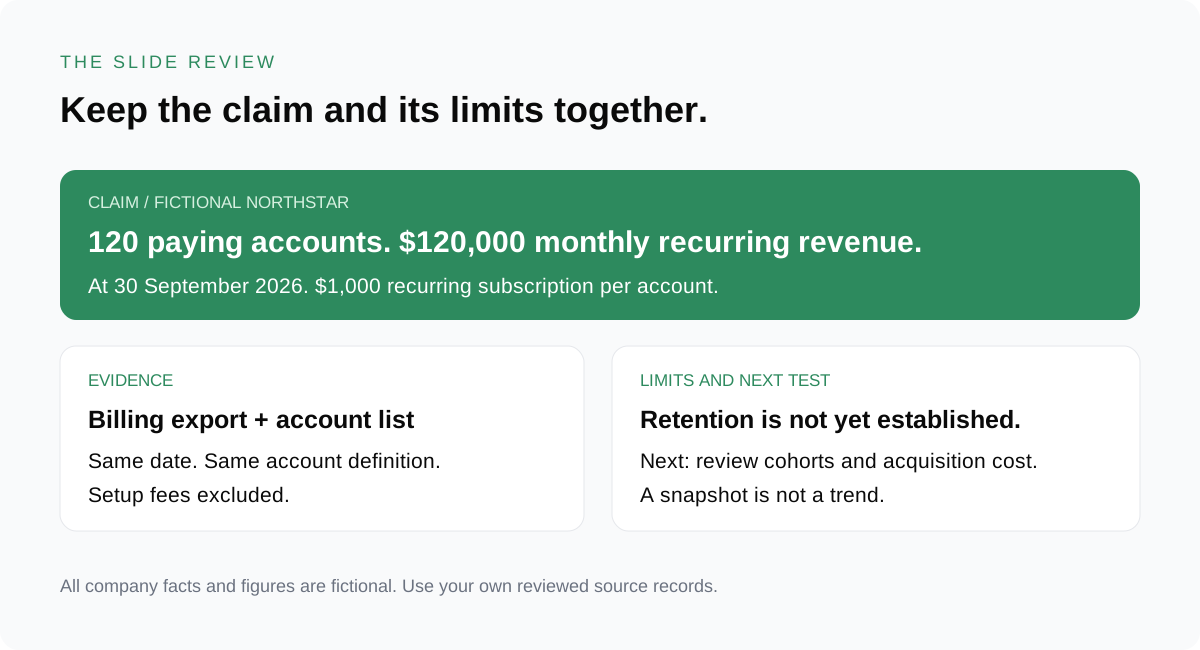
Use operating definitions that match your records.
Monthly revenue, recurring revenue, bookings and cash collected are different measures. If a chart shows recurring revenue, say which contracts are included and when the measure was calculated. If pilots are unpaid, label them. If a customer cancelled, avoid quietly keeping that logo in a current customer count.
Show the same definition across comparable periods. A percentage without a starting value can conceal a very small base. A cumulative chart can conceal recent changes. Keep the period and currency visible, and explain any change in measurement.
Show market arithmetic without pretending it is demand.
For a fictional illustration, 8,000 relevant companies at an assumed annual price of $12,000 gives $96 million of annual revenue opportunity. That is the product of two assumptions, not a forecast of sales. You still need to verify which firms can buy, how many you can reach, how pricing changes across segments and what competitors already serve.
Keep the broad opportunity separate from the initial segment and your near term sales plan. A number from a large industry report may help explain context, but it does not identify your buyer. The market worksheet should expose the assumptions a reader might challenge.
Describe progress honestly before revenue.
If you have not launched or charged customers, say so. Show the evidence relevant to your stage: a completed technical test, product usage, a defined pilot, a customer problem observed repeatedly or a regulatory milestone. Describe the next uncertainty rather than inventing recurring revenue or implying that a letter of intent is cash.
3. Turn a vague traction slide into a reviewable one.
Northstar Cloud is a fictional company. The following dataset is invented for this writing exercise and is separate from the historical demo deck in the PitchLab screenshots. No customer outcome or benchmark is claimed.
“Strong traction. Customers love our platform. Huge market opportunity.”
“120 paying customer accounts at 30 September 2026. $120,000 of monthly recurring revenue under our stated definition. Retention and channel efficiency remain the next tests.”
| Element | Fictional example | Why include it? |
|---|---|---|
| Customer definition | 120 active paying accounts at period end. | Distinguishes accounts from individual users and unpaid trials. |
| Revenue definition | $1,000 recurring monthly subscription per account; excludes setup fees. | 120 × $1,000 = $120,000 monthly recurring revenue. |
| Evidence source | Billing export reconciled to the account list, dated 30 September. | Gives the founder a record to check and produce. |
| What is not established | No retention cohort or acquisition cost is supplied in this example. | Prevents the snapshot from implying those questions are resolved. |
| Next test | Review retention by starting cohort and measure one acquisition experiment. | Names the evidence the next discussion needs. |
The example is more precise because it exposes the meaning of the numbers, not because the headline is longer. On an actual slide, keep the central message readable and move the supporting detail to a source note or appendix. Make that detail available when someone asks.
SLIDE: [Number and topic]
MAIN MESSAGE: [One sentence a reader should understand]
EVIDENCE: [Source, date, reporting period and definition]
ASSUMPTIONS: [What has not yet been verified]
VISUAL: [Chart, product step or comparison that proves this point]
READER QUESTION: [Likely question and the supporting record]
NEXT REVISION: [One concrete change]
OWNER: [Who checks the facts and approves the revision]
4. Connect the funding ask to an operating plan.
State the amount and currency you are seeking, the work it enables, the milestones you intend to reach, and the main cash assumptions. Keep this consistent with your financial model. A use of funds pie chart can explain allocations, but it cannot establish when cash runs out or when a milestone is achievable.
For a fictional planning example, Northstar is seeking $2 million. Suppose it has $600,000 of available cash, receives the full raise immediately and spends a constant $150,000 of net cash per month. The simple calculation is ($600,000 + $2,000,000) ÷ $150,000, or about 17.3 months.
That illustration ignores fundraising costs, restricted cash, changes in collections, timing of the raise and future spending changes. It is not a cash forecast. If the company hires in phases or collections are uneven, use a month by month cash schedule and state the month being shown.
Describe what becomes possible during that period: which product work, customer validation or hiring decision is funded, who owns it and how progress will be checked. Present a lower funding scenario when it changes the plan materially. Keep the amount requested separate from an investor commitment and from cash already received.
Use the founder dilution guide to review the ownership assumptions separately. Avoid hiding a proposed valuation inside a runway number.
5. Check both the presentation and the version sent afterwards.
A deck that works while you narrate it can leave unanswered questions when it is forwarded. Add descriptive headlines, legible labels and enough context for someone to follow the argument without hearing the talk. Keep supplementary details accessible rather than crowding the core story.
YC’s deck design guidance recommends clear, readable slides that communicate one main idea. That article addresses Demo Day presentations; apply the clarity principles while adapting the amount of detail to your own meeting and reading context.
Open the exported PDF on a laptop and phone. Check that charts, axis labels, dates and footnotes survive export. If an image is essential to explain the product, show the relevant workflow with enough detail to understand it. Use a tested backup if a live demonstration depends on a connection.
Ask a reader unfamiliar with the company to explain what it does, why the customer needs it and what remains uncertain. Record where they have to guess. Revise those gaps before polishing animation or adding more slides.
How to use PitchLab to review and share the deck.
PitchLab lets you evaluate a deck and manage recipient links. Full access and evaluation allowances depend on your account and current plan. These screenshots come from the product with a fictional Northstar deck, invented investor labels and simulated evaluation responses. They show a workflow, rather than validated claims about a real company.
1. Confirm which deck version you are reviewing.
Upload the PDF through the dashboard, then open PitchLab. Confirm the deck name, slide count and version before requesting a review. The screenshot shows a twelve slide demo; this does not prescribe the number your deck should contain.
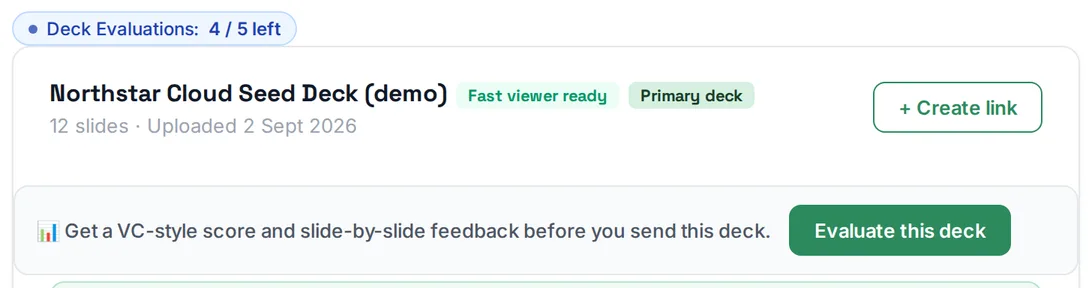
2. Read the comments beside the original slide.
Use “Evaluate this deck” when your account has access. Read the slide feedback alongside the source material and check whether a suggested revision is supported by your records. The interface names the evaluation report “DeckLab”; it is the deck review within PitchLab.
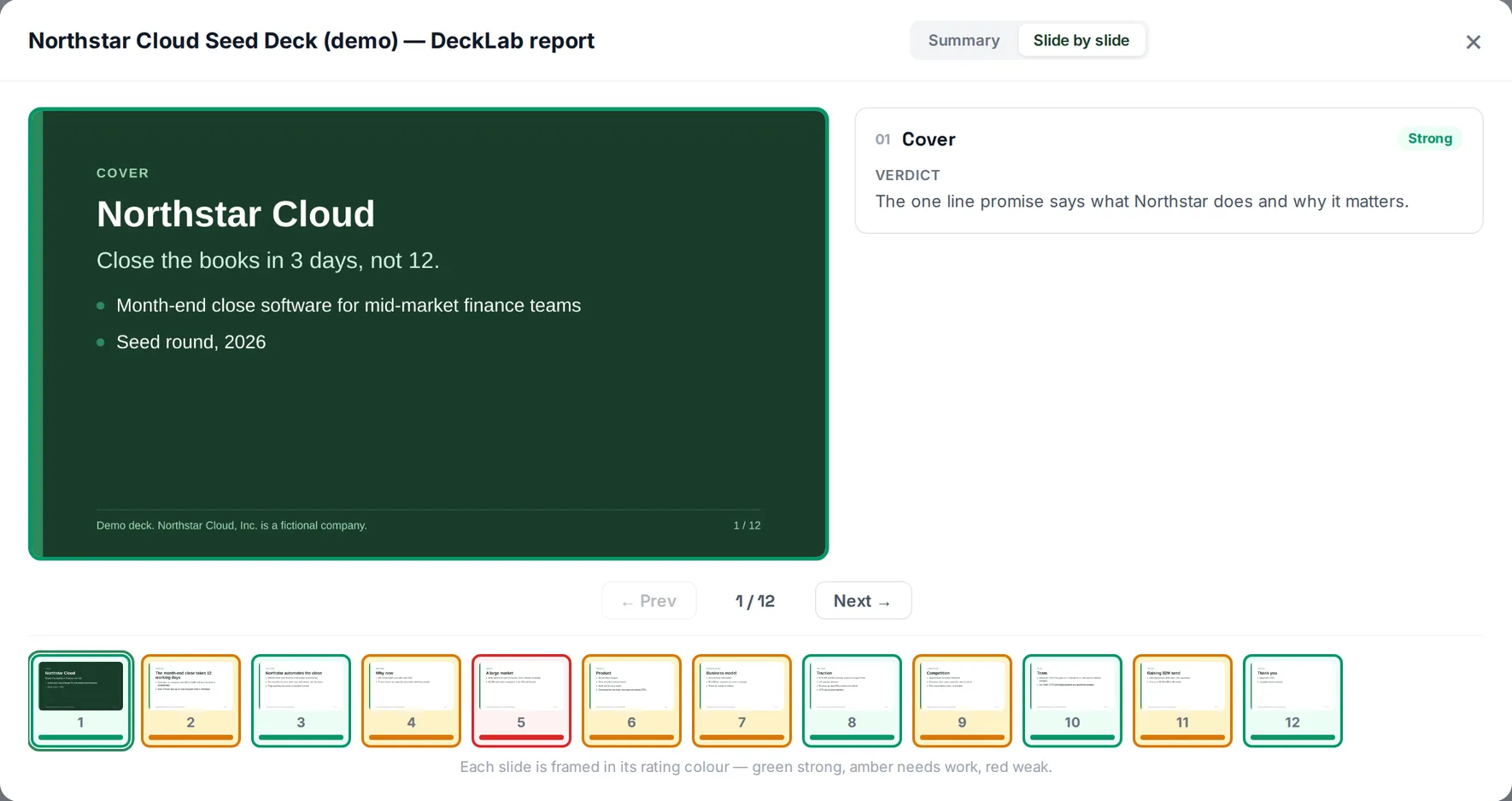
Treat feedback as a prompt for review. If a score suggests adding market or economics detail, do not manufacture numbers to satisfy the rubric. Add verified facts, explain limitations, or name the evidence you still need.
3. Review access before creating a recipient link.
Choose “Create link”, label the intended recipient and decide whether to allow PDF download. Test what the recipient can actually see. A recipient label helps you organize a link; it should not be treated as proof of the identity of everyone who opens it.

Replacing a deck with a new version updates the content shown by its existing links. Adding a separate deck gives it its own links. Keep a record of the version discussed at each meeting, and check existing recipient links before replacing a file.
Opens and time per slide record viewer activity, not verified investor understanding or intent. A forwarded link may be opened by someone else. Use the actual reply and meeting questions to decide what to do next.
Explore a sample slide review.
Choose one of three fictional slides: Problem, Traction or Ask. A free account lets you view and save the editorial sample feedback, then explore another slide. This preview does not upload your deck, analyse it with AI or produce an evaluation score.
Your result
Enter the details to see what this preview can help you work through.
Your inputs are ready.
Create a free account or log in to view and save the result. No payment required.
Continue with the complete workflow in PitchLab.
Explore PitchLab →Before you share: review the story and the evidence.
Your selections remain on this page and reset when it reloads. Completing this checklist records your review; it does not verify the facts for you.
0 of 8 reviewed
Common questions
How many slides should a seed pitch deck have?
Use the number needed to explain the core argument clearly in the available time. There is no required count in this guide. The planning table is a set of questions, not a mandated slide order. Keep deeper evidence in an appendix when it interrupts the main story.
What should I show if the company has no revenue?
Say that clearly. Show the customer problem, product or technical progress, evidence from relevant tests, what you learned and the next uncertainty. Describe pilots and commitments accurately. Do not label unpaid activity as paying customers.
Does a high PitchLab score mean investors will fund us?
No. The evaluation reflects the tool’s rubric and the material submitted. It cannot establish market demand, verify every claim or predict an investment decision. Review the suggested changes against your own evidence.
Should the deck include detailed financial projections?
Include enough financial information to explain the raise, cash plan and operating assumptions. The detail depends on the company, stage and investor process. Keep a supporting forecast for questions that require it, and label projections as estimates rather than achieved results.
Sources and further reading
Sources reviewed on 3 October 2026. The worksheet, evidence register and Northstar examples are our educational framework. The sources below support presentation principles; neither validates the fictional figures or predicts funding.
- Y Combinator: A Guide to Seed Fundraising, 7 January 2016. The “Documents You Need” section explains the role of a coherent presentation and reading deck. Its historical financing statistics and market ranges are not used here.
- Y Combinator: How to Design a Better Pitch Deck. Guidance for making a Demo Day presentation readable and clear; that presentation context differs from a full investor meeting.
- PitchLab overview. Product scope. Screenshots use the fictional capture and simulated review described above.