Give every active conversation a next action.
Organize investor outreach by qualifying the firms, tracking the actual stage of each conversation, and assigning one owner, next action and review date to every active record. Log what you sent and what the investor said. Follow up against an agreed date or a deliberate review decision, and stop chasing a clear pass.
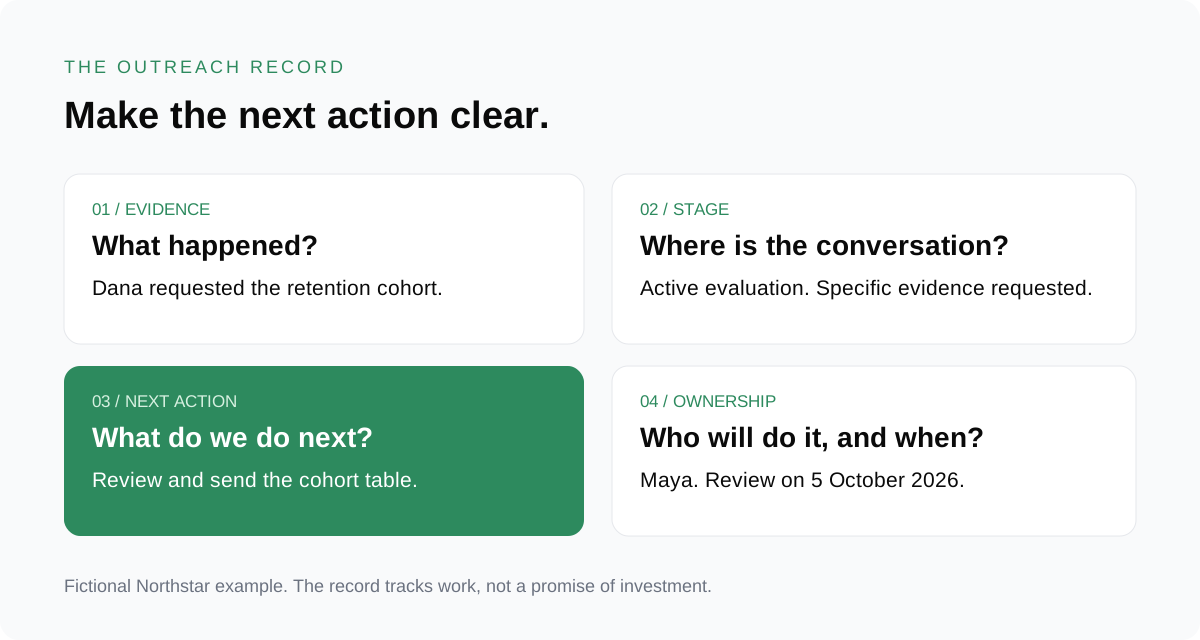
You can do this in a spreadsheet or a fundraising CRM. The format matters less than whether two people can read the same record and agree on what happened. “Interested” is too vague. “Partner requested customer retention data; Maya will send the reviewed cohort on Monday” is a usable record.
The stages and review routine below are our practical framework, rather than a prediction of how investors will behave. All company, investor and contact examples are fictional. The tracker, templates and checklist work without signup; the FundLab practice preview requires a free account.
1. Start from investor fit, then choose the contact.
Before scheduling outreach, check stage, sector, geography, cheque size, portfolio conflicts and whether the firm is currently investing. Record a source and the date you checked it. A database label is a starting point for verification, rather than evidence of interest in your company.
Use our investor shortlist guide for that research. This guide starts where the shortlist ends: identifying a relevant person, choosing an appropriate route and managing the conversation.
Choose the person whose role and stated focus fit the task. If you can request an introduction, record who will make it and whether they agreed. An introduction request is a separate event from the introduction arriving.
For a direct email, state what the company does, the evidence of progress, why the conversation is relevant and what you are asking for. Keep the reason specific and verified. In YC’s conversation with Aaron Harris, he recommends researching the recipient and making a clear, concise request.
Give the firm one coordinated approach. Keep separate contact histories when needed, but agree who owns the relationship. Two cofounders independently chasing different partners at the same firm can leave everyone with a different account of the raise.
2. Define stages using events you can verify.
A stage should describe the current conversation. Keep your own next action in a separate field. A friendly reply, a deck view and a partner meeting carry different information; merging them into “hot lead” hides the work still required.
| Stage | Evidence required | Useful next action |
|---|---|---|
| Qualified | Fit checked; relevant contact or route identified. | Review the message or request a specific introduction. |
| Introduction requested | A connector has received your request. | Check the agreed handoff; do not count it as investor contact yet. |
| Contacted | Your message was actually sent, with date and channel recorded. | Review for a reply or delivery failure on the chosen date. |
| Conversation started | A substantive reply, rather than an automatic response. | Answer the question or agree the next meeting. |
| Meeting scheduled | A date and participants are agreed. | Prepare, then record questions and the agreed next step. |
| Active evaluation | Specific information, references or another meeting requested. | Deliver the requested evidence and clarify their decision process. |
| Terms under discussion | Actual terms or a term sheet are being reviewed. | Coordinate review, outstanding conditions and closing work. |
| Parked or passed | A timing condition, clear decline or your decision to stop chasing. | Record the reason. Revisit only when there is a relevant change or agreement. |
Adapt these stages to the process you use. FundLab’s own labels differ, including Shortlisted, Emailed, Replied and Meeting Set. A saved draft is not a sent message. Terms under discussion are not funds received; keep completion evidence separately.
3. Keep one record that another person can act on.
For a small raise, one row per firm is a useful starting point. Put contact details and dated events in linked notes or a contact tab if one cell becomes unwieldy. Keep the firm’s decision separate from the activity of individual people.
| Field | What to write |
|---|---|
| Firm and contact | The firm, person, role and contact route you have checked. |
| Fit and evidence | Why they fit, source URL, verification date and open questions. |
| Stage and last event | The stage, plus the dated message, request or decision supporting it. |
| Next action | A concrete task: “Send the requested cohort table”, rather than “Follow up”. |
| Owner and review date | Who will act and when the record should be reviewed. This is not always a send date. |
| Thread and materials | The conversation link and the deck or document version already shared. |
| Outcome or revisit condition | The stated reason for a pass, timing request or relevant future milestone. |
The Excel workbooks open in spreadsheet tools. The example is a fictional snapshot as of 5 October 2026, used to illustrate the decisions below. Keep private contact data and sensitive documents within the access scope you intend.
FIRM / PERSON: [Name, role and checked contact route]
FIT: [Reason, evidence source and date checked]
CURRENT STAGE: [Stage supported by a real event]
LAST EVENT: [Date, channel and what actually happened]
THEIR REQUEST: [Exact question or requested evidence]
NEXT ACTION: [One concrete task]
OWNER: [Who will do it]
REVIEW DATE: [Date and time zone if relevant]
SHARED MATERIALS: [Thread link and document version]
OUTCOME / REVISIT CONDITION: [Pass, timing, milestone or unknown]
4. Review the work, rather than just counting messages.
During an active raise, reserve a short review block on the days you are working on outreach. First answer real questions and complete promises. Next resolve bounces or missing contact details. Then review unanswered messages, and finally prepare new approaches that fit the raise.
At a weekly review, check how many qualified firms were contacted, how many substantive replies arrived, what meetings actually happened and what remains in evaluation. Keep denominators and time periods explicit. Ten contacts within one firm are not ten independent investor decisions.
Use these numbers to locate the next question, rather than inventing a success target. If qualified firms are not responding, inspect fit, route, message and delivery. If meetings produce the same unanswered question, improve the supporting evidence. If requested information is late, fix the internal handoff.
Keep several appropriate conversations moving during a defined fundraising period so one delay does not stop all progress. Harris’s discussion of fundraising process supports working across conversations in parallel. The size of that group should still match your capacity to prepare and respond well.
5. Follow up with context and a decision.
There is no universal best follow-up interval. Start with the date the investor agreed to. If no date was discussed, choose a review date that fits the relationship and your current process. At that review, decide whether a message is useful; a reminder should not make that decision for you.
Distinguish three situations. After no reply, keep the original context and a clear ask. After a meeting, close the loop on their actual question. After “come back later”, ask what changed evidence would make the next conversation useful and record the condition.
Subject: Northstar Cloud | retention review and next step
FICTIONAL EXAMPLE. Replace every detail before using.

Hi Dana,

Thank you for discussing Northstar on Friday. You asked how we measure customer retention and whether the recent onboarding changes affected it.

I’ve included the reviewed cohort table with the definitions, reporting period and limitations we discussed. The observations are separate from our forecast.

Would a short conversation next week help resolve the remaining questions? If another person should review the table first, please let me know.

Maya
Send requested material only after checking the facts, recipients and access. Keep the conversation in the original thread when that helps the recipient follow it. A relevant update can justify reconnecting; an invented deadline or an unsupported claim that other investors are committing should not appear in your message.
Record silence as silence. If you stop chasing, record your own decision to park the conversation rather than inventing an investor pass. If the investor declined or asked you not to contact them again, close the active outreach.
A worked pipeline review: four records, four different actions.
Northstar Cloud and every firm and person below are fictional. Assume Maya is reviewing the raise on 5 October 2026. These scenarios are separate illustrations from the historical demo screens further down.
| Record | Evidence so far | Maya’s next action |
|---|---|---|
| Example Ventures / Dana | A meeting on 2 October. Dana asked for the retention cohort. | Send the reviewed table on 5 October and ask who reviews it next. |
| Summit Ventures / Jordan | An email on 28 September. No reply or delivery failure recorded. | Review the contact and original ask on 6 October, then decide whether to send a concise follow-up. |
| Harbor Point / Lee | The email returned a delivery failure on 1 October. | Verify the address or find an appropriate alternative contact before another send. |
| Lakeside Growth / Chris | Chris declined on 30 September because the company is outside the firm’s stage. | Record the stated reason and close active outreach. Do not send a routine chase. |
All four rows might look overdue in a badly designed list. Only one needs the evidence the investor requested. One needs a judgment about another message, one needs contact repair and one needs no further chase. The recorded event determines the action.
How to use FundLab for the outreach routine.
FundLab brings firm records, people, conversation history and outreach actions into one board. Full access depends on your account and current plan. The screenshots here were captured from FundLab’s own interface with fictional Northstar records and simulated provider responses. No message, mailbox draft or LinkedIn action was sent to a real person.
1. Bring the qualified firms onto the board.
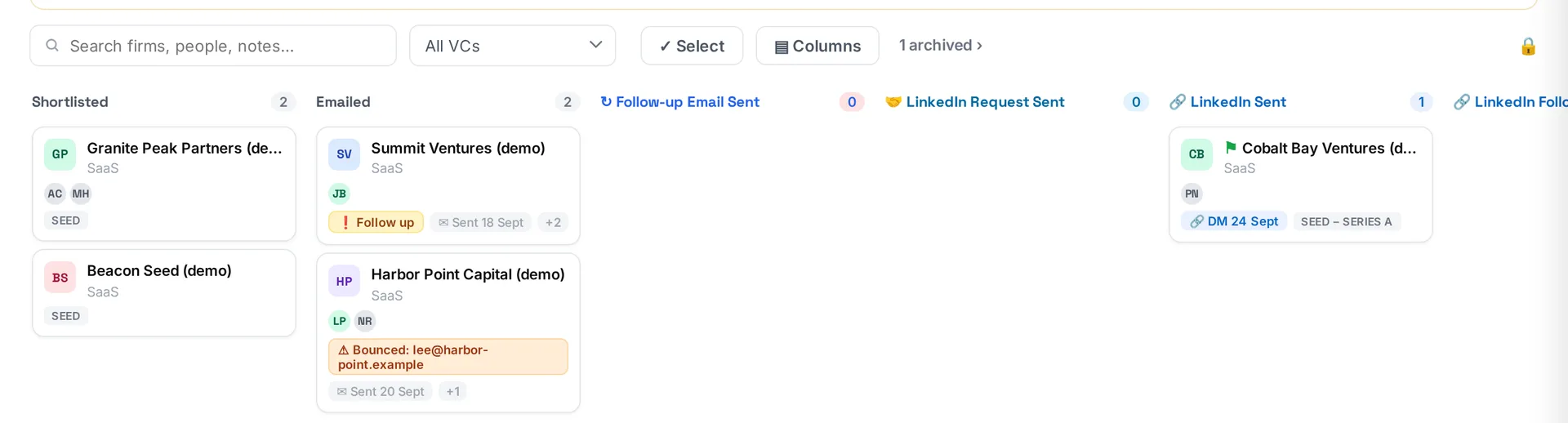
Add firms manually or bring a shortlist from VCLab. Review the people and source evidence before approaching them. The board uses stages such as Shortlisted, Emailed, Replied and Meeting Set, with additional channel and activity labels.
2. Keep the next action beside the relevant person.
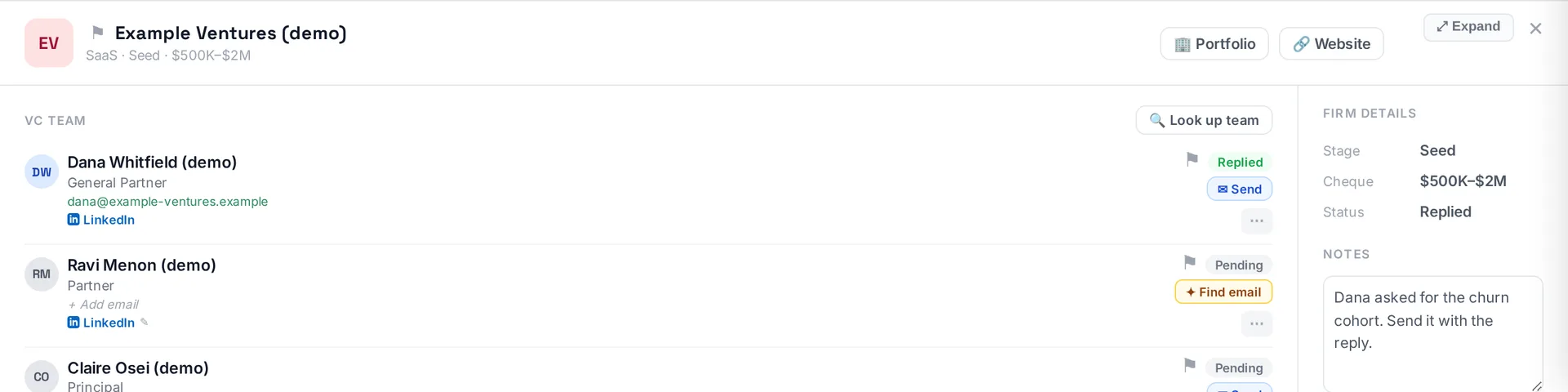
Open the firm’s workspace to review contacts and notes. Record what was requested, who owns the response and when you will review it. A firm with three contacts still needs one coordinated account of the conversation.
3. Review the suggested actions before using them.
“Needs you today” surfaces events such as a bounce, a reply awaiting your response, recent deck activity and an unanswered message. Treat those suggestions as a review queue. A deck view is a recorded interaction with a tracked link; it does not establish who viewed it or whether someone intends to invest. “Deck Opened” is not an email open measurement.

4. Review the message and choose the action deliberately.
The full tool can send email or save a mailbox draft through a connected Gmail, Outlook or Zoho Mail account. Check the recipient, subject, content, signature and document links first. Saving as a draft is a separate action from sending; sending limits and lookup allowances depend on the workflow and account.

FundLab reads supported mailbox threads for replies. A phone call, an in-person conversation or a LinkedIn reply may require you to update the record manually. LinkedIn messages are copied for you to send yourself; record the action only after sending it. Keep the board aligned with what actually happened.
The practice preview below is smaller: it saves an example of a stage and next action. It does not research contacts, connect a mailbox or send a message.
Practise one stage and one next action.
Use a fictional prospect to turn a vague reminder into a concrete task. A free account lets you view and save one practice record, then revise it. The preview’s simplified stages are an educational exercise; they are not a copy of the full FundLab board.
Before you send: check the record and the request.
The selections stay on this page and reset when it reloads. Completing the checklist records your review; it does not independently verify the evidence.
0 of 8 reviewed
Common questions
Do I need a CRM to organize investor outreach?
A spreadsheet can work when you can keep the records consistent and assign the work clearly. A CRM becomes useful when you need linked contacts, threads and shared review across more conversations. Start with the information and routine you need, then choose a tool that supports them.
How often should I follow up with an investor?
Use an agreed date first. If none exists, set a review date appropriate to the relationship, then decide whether another message adds useful context. There is no universal interval supported by this guide. Stop routine follow-ups after a clear decline or request to stop contact.
Should I mark an investor as interested after a deck view?
Record the view as a link interaction and keep the conversation stage supported by actual communication. A tracked view does not establish identity, decision authority or investment intent. Ask a useful next question without overstating what the signal means.
What should I record after an investor meeting?
Record the participants, questions, requested evidence, your commitments and any agreed review date. Assign the next action to one person. If the investor has not explained the decision process, make that an open question rather than filling it in yourself.
Sources and further reading
The pipeline stages, tracker, routine and examples are our educational framework. Sources were reviewed on 3 October 2026. They support specific communication principles; they do not validate the fictional scenarios or establish response rates.
- Y Combinator: Aaron Harris on Fundraising and Meeting with Investors, 21 August 2019. Recipient research, clear requests and running fundraising conversations in parallel.
- The Fundraising Library: How to build an investor shortlist. Evidence and fit checks before outreach.
- FundLab overview. Product scope and the full workflow. Screenshots in this article use the fictional demo capture described above.