
What is founder dilution, and how do you calculate it?
Founder dilution is a reduction in your ownership percentage when the company adds shares or other equity claims. For a simple priced round, new investor ownership = new investment ÷ (pre-money valuation + new investment). Each existing holder’s new percentage = their old percentage × (1 − new investor ownership).
A $2 million investment at an $8 million pre-money valuation gives the new investor 20%. A founder who owned 60% then owns 48%: a loss of 12 percentage points, or 20% relative dilution.
That shortcut assumes all the investment buys newly issued shares at one price, the starting ownership is complete, and there are no converting instruments, pool changes or other issuances. Once those appear, build the full before-and-after cap table.
This guide uses a fictional company to show the arithmetic, compares pool assumptions and walks through CapLab. The article, examples and worksheet are public. The preview for your own numbers requires a free account to view and save a result.
1. Confirm what “before the round” includes.
Start with the current share counts and agreed ownership basis. A cap table is the record of holders, their securities and their stakes. A pro forma cap table models what those stakes would become after a proposed transaction.
Use the same denominator throughout. As-issued ownership counts the shares currently issued. A fully diluted view also includes the equity that would exist under the stated conversion and option assumptions. Say whether your numbers include granted options, the unallocated reserve, warrants and converting instruments.
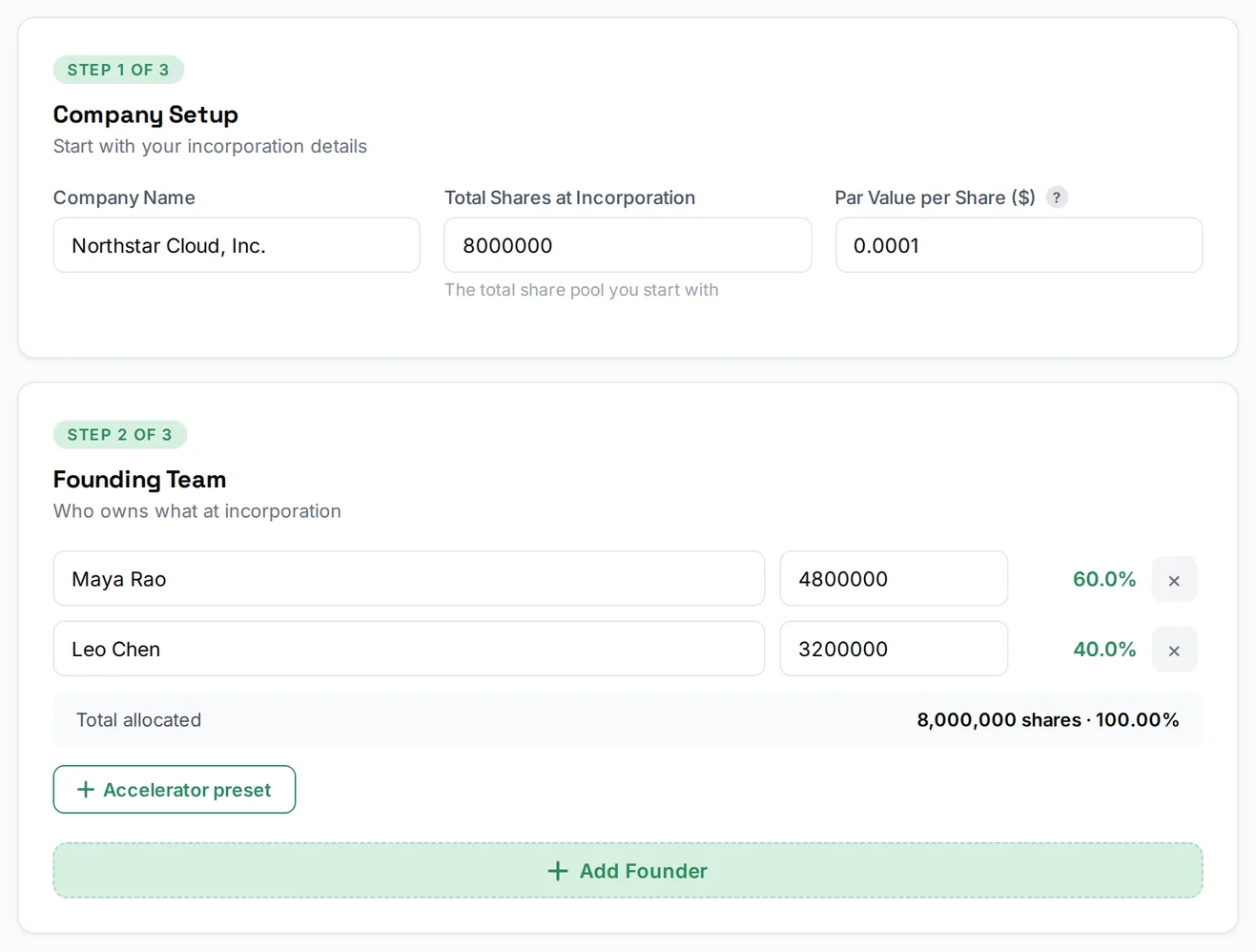
Our starting example has just two founders and 8,000,000 common shares. There are no earlier investors, options, SAFEs, notes, warrants, fees paid in equity or secondary sales. That makes the as-issued and fully diluted percentages identical at the start.
| Holder | Existing shares | Starting ownership |
|---|---|---|
| Maya Rao | 4,800,000 | 60% |
| Leo Chen | 3,200,000 | 40% |
| Total | 8,000,000 | 100% |
Reconcile your own records before projecting the next round. If the holders do not sum to the stated total, a precise-looking result will still start from the wrong position.
2. Work through a priced round, one calculation at a time.
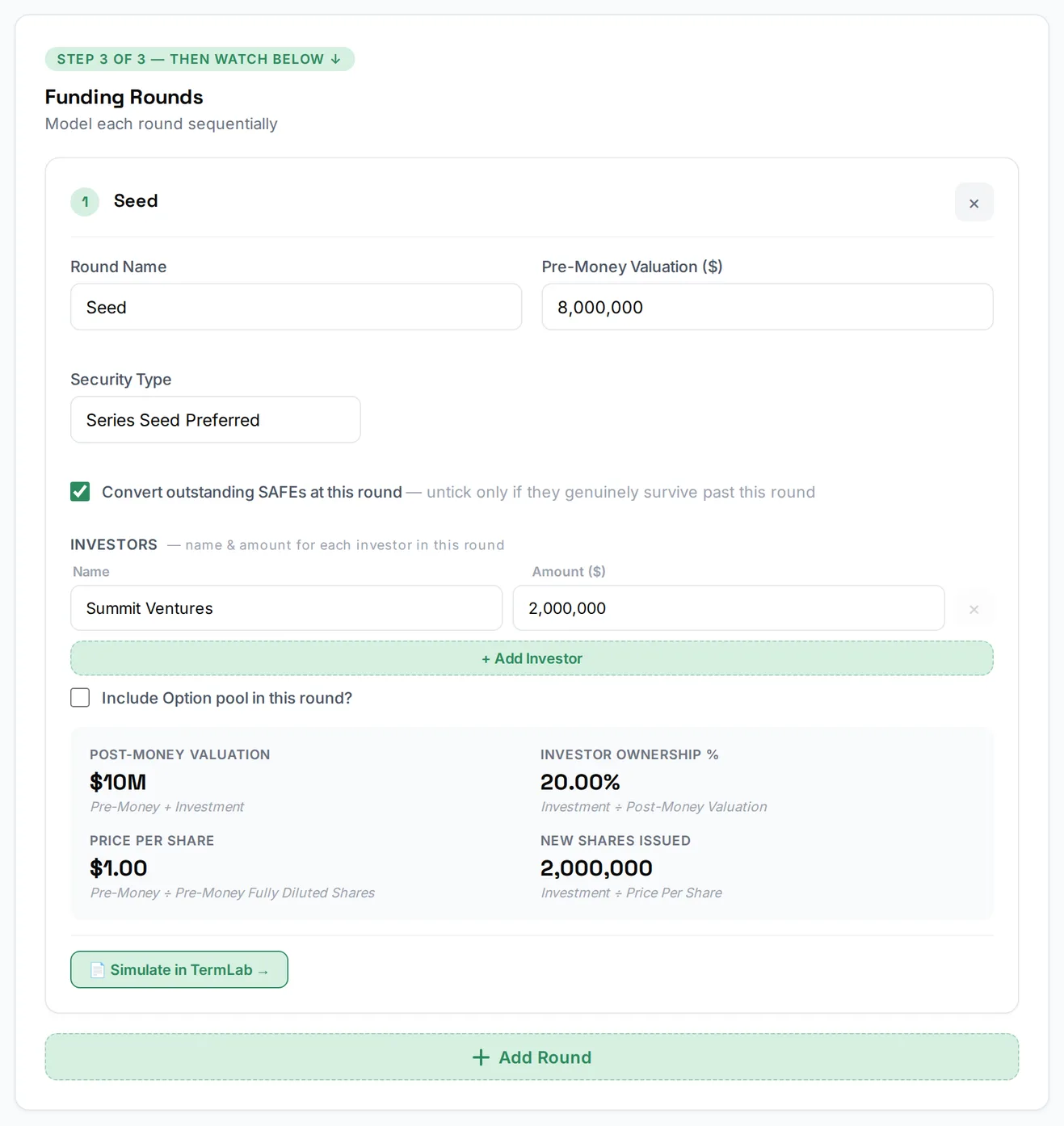
Northstar Cloud, Inc., Maya, Leo and Summit Ventures are fictional demo names. All amounts are illustrative USD figures. Summit invests $2,000,000 at an $8,000,000 pre-money valuation. No option pool is added.
- Post-money valuation: $8,000,000 + $2,000,000 = $10,000,000.
- Price per share: $8,000,000 ÷ 8,000,000 existing shares = $1.
- New investor shares: $2,000,000 ÷ $1 = 2,000,000.
- Total shares after the round: 8,000,000 + 2,000,000 = 10,000,000.
- Each holder’s ownership: their shares ÷ 10,000,000.
| Holder | Shares after | Before → after | Change |
|---|---|---|---|
| Maya | 4,800,000 | 60% → 48% | −12 percentage points |
| Leo | 3,200,000 | 40% → 32% | −8 percentage points |
| Summit Ventures | 2,000,000 | 0% → 20% | New holder |
| Total | 10,000,000 | 100% → 100% | Reconciles |
The founders have the same number of shares as before. Their percentages fall because those shares are now part of a larger total. Both retain 80% of their original percentage stake.
Percentage points and relative dilution answer different questions. Maya’s percentage-point loss is 60 − 48 = 12. Her relative dilution is (60 − 48) ÷ 60 = 20%. Write both clearly when you discuss the deal.
The basic relationships are also set out in Carta’s explanation of pro forma cap tables. Our numbers are independently worked examples, not market valuation benchmarks.
3. Change one assumption and compare the result.
Keep the $8 million pre-money valuation and the 60/40 founder split. What happens if Northstar raises $3 million instead of $2 million?
$2M raised: founders retain 80% together.
$10M post-money. New investor: $2M ÷ $10M = 20%. Each founder retains 80% of their starting stake.
$3M raised: founders retain about 72.73% together.
$11M post-money. New investor: $3M ÷ $11M ≈ 27.27%. Each founder retains about 72.73% of their starting stake. Figures are rounded for display.
The extra $1 million increases investor ownership from 20% to about 27.27%. To judge that trade, connect the money to a spending plan, runway and milestones. The lower-dilution offer is not automatically the better offer.
Across rounds, multiply the remaining stakes.
Two successive rounds that each dilute existing holders by 20% leave them with 0.8 × 0.8 = 64% of their original stake, assuming they buy no new shares and nothing else changes. Maya’s 60% becomes 48%, then 38.4%. Cumulative relative dilution is 36%, not 40%.
4. Ask when the option pool is created, and what the percentage means.
A pool reserves equity for employee awards. Creating or enlarging it changes fully diluted ownership even before every option is granted. Carta’s option-pool guide explains the timing distinction: a pool included before new investment is borne by existing holders; a pool added afterwards also dilutes the incoming investor.
“A 10% pool” is incomplete without a reference point. Is that 10% immediately before the financing, or 10% of the fully diluted company at closing? Is it the whole pool or an additional reserve? Ask before comparing offers.
Here are four separate illustrations using the same $8M pre-money and $2M investment, with no initial pool. The examples assume the reserve is included in the ownership denominator as described.
| Pool assumption | Founders together after | Investor after | Pool after |
|---|---|---|---|
| No pool | 80% | 20% | 0% |
| 10% of the pre-round total, created before investment | 72% | 20% | 8% |
| 10% of the final total, reserved before investment | 70% | 20% | 10% |
| 10% of the final total, created after investment | 72% | 18% | 10% |
In the second row, founders first retain 90%, then 80% of that: 90% × 80% = 72%. The pool also shrinks through investment: 10% × 80% = 8%. In the third row, the investor’s 20% and the final pool’s 10% leave founders 70%. That requires a 12.5% pool immediately before the investment, since 12.5% × 80% = 10%.
In the last row, the financing first leaves founders at 80% and the investor at 20%. Creating a final 10% pool then leaves each with 90% of that stake: founders 72%, investor 18%. These rows are different transactions, not interchangeable labels for one deal.
Check the tool’s pool basis too. CapLab’s simple pre-money pool input uses the percentage immediately before the priced round. Entering 10% there produces an 8% pool after a 20% investor round. A term sheet asking for 10% at closing needs different inputs. Existing pools and convertibles require a fuller model.
5. Include the commitments you made before this round.
A SAFE or convertible note can add shares at a different conversion price from the new investor. Record each instrument’s principal, cap, discount, version and conversion terms. For a note, also check accrued interest and the contractual trigger.
A post-money SAFE cap and a priced round’s post-money valuation are different concepts. YC’s SAFE documents and explanations distinguish the SAFE funding from the later equity financing and its new pool. Do not put every earlier cheque into the simple priced-round formula and assume you have modelled the conversions.
Also separate primary investment from secondary sales. Primary investment buys new company shares and changes the denominator. A secondary purchase transfers an existing holder’s shares; the company does not receive that purchase price and the transfer itself does not create new shares.
If earlier investors exercise participation rights, count their new investment and shares separately. An ownership percentage alone does not describe voting control or exit proceeds; the rights attached to each security matter too. Have the final model checked against the proposed documents.
How to work through the same example in CapLab.
These are real CapLab screenshots from the existing help capture, using fictional Northstar demo data. They show the no-pool example above, rather than a customer’s records. CapLab includes learning, a live registry and scenario modelling. The full scenario and export workflow requires the relevant plan access; the free preview below covers one simpler round.
Start with the share counts.
In the Build workflow, use a sandbox scenario for a proposed transaction. Enter Northstar’s 8,000,000 starting shares, then Maya’s 4,800,000 and Leo’s 3,200,000. Choose the company’s region and currency. Par or face value, where relevant, is different from the financing’s price per share.
Add the proposed priced round.
Name the round, enter $8,000,000 pre-money and $2,000,000 of new investment. Leave the option pool off for this example. Check the security type and any conversion settings against your actual documents; the demo has no outstanding SAFEs to convert.
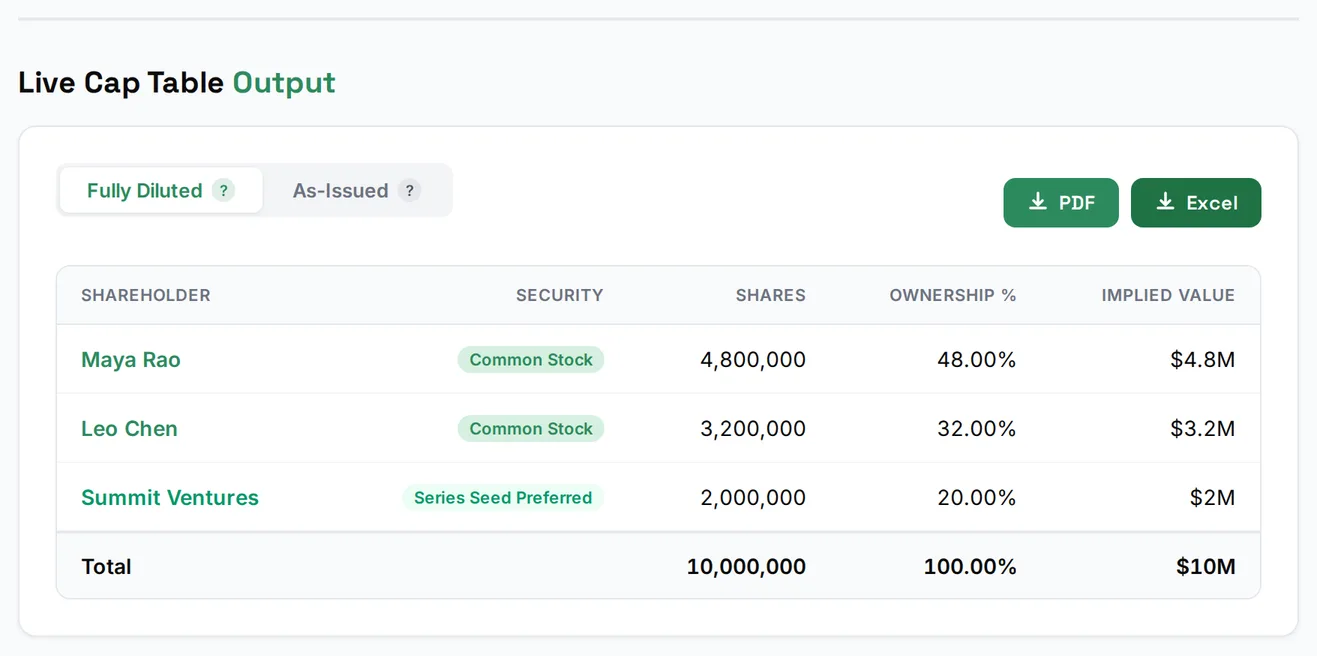
Review the ownership table and the change for each founder.
Check that every holder appears and the total is 100%. Use the Fully Diluted and As-Issued views consistently. In this example they match because there is no option reserve or other pending equity.
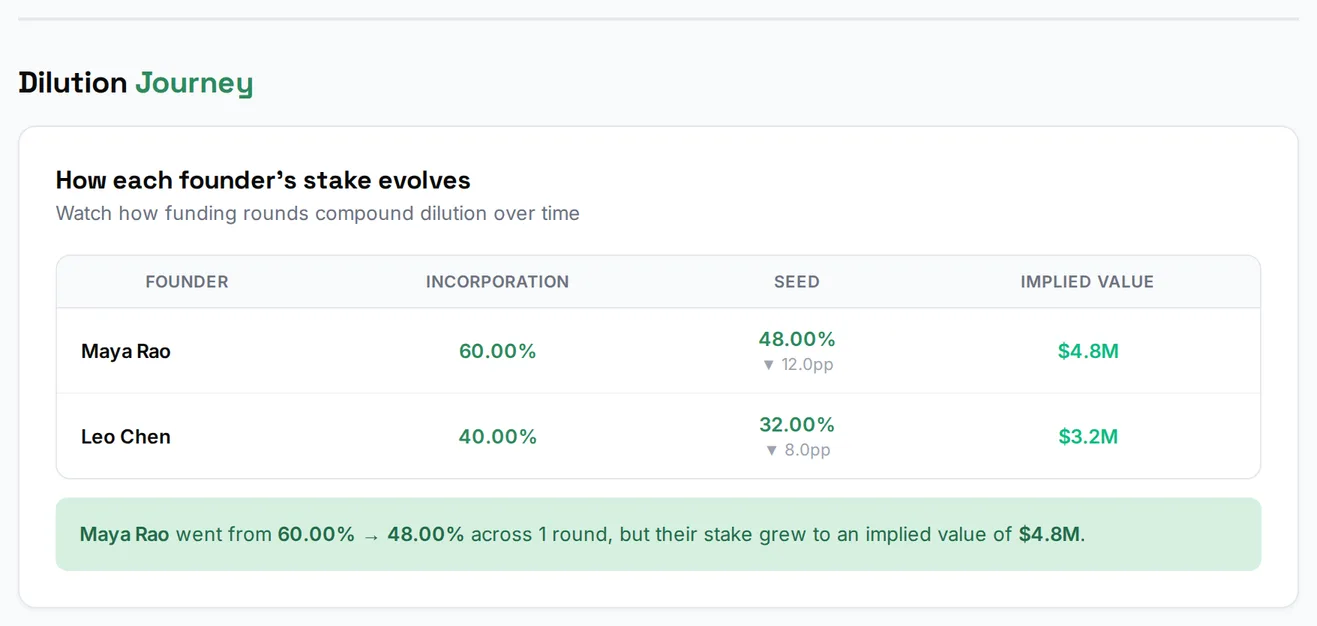
Revise one assumption in a scenario, then compare it with the original. Keep proposed terms out of your live ownership record until the transaction is completed and reconciled. For pools, check the complete ownership table rather than relying only on the Quick Calculator’s “Your Dilution” figure, which reflects investor issuance. This distinction matters whenever a pool changes the ownership denominator.
Try your own numbers in the CapLab preview.
Enter two founders whose starting ownership adds up to 100%, a pre-money valuation and one new investment. To reproduce Northstar, use USD, 60%, 40%, 8,000,000 and 2,000,000.
A free account is required to view and save your result. This preview saves one scenario that you can revise. It excludes option pools, earlier investors, SAFEs, notes, fees and secondary sales. Your inputs are sent to the platform when you run it.
Your result
Enter the details to see what this preview can help you work through.
Your inputs are ready.
Create a free account or log in to view and save the result. No payment required.
Continue with the complete workflow in CapLab.
Explore CapLab →Before you compare offers or quote your dilution.
Use this review to collect the assumptions with the result. Checking a box records your own review; it does not verify the underlying documents.
0 of 7 reviewed
The worksheet records your inputs, an example and questions to resolve. It is a text document, not an automated spreadsheet.
Common questions about founder dilution.
Is dilution calculated from pre-money or post-money valuation?
For the simple priced round, the new investor’s percentage is investment divided by post-money valuation. If you are given pre-money, add the primary investment first. If an $8M figure is already post-money, $2M buys 25%, not the 20% it would buy at $8M pre-money.
Does dilution mean I lose shares?
Not necessarily. In the Northstar example, founders keep their share counts while the company issues new shares. Their percentages decrease. A founder selling existing shares is a separate transaction.
Is 20% dilution the same as losing 20 percentage points?
No. A 60% stake diluted by 20% becomes 48%. That is a 12 percentage-point loss. Relative dilution = (old ownership − new ownership) ÷ old ownership. If the starting stake is zero, that relative measure is undefined.
What is a normal or acceptable amount of dilution?
There is no single figure that tells you whether your deal is sensible. Compare what the capital can achieve, all the equity being issued, the pool, the rights and your expected future financing needs. The illustrative figures here are not a recommendation or a market benchmark.
Can I use the simple formula when I have SAFEs or notes?
It is only a starting point. Model each conversion according to its terms, add the shares and any pool adjustment in the correct order, and reconcile the final table. Do not use the no-pool preview as the complete answer to a round with convertibles.
Do these calculations work in INR or SGD?
The basic ownership arithmetic works with any currency if all amounts use the same currency and basis. Securities, documentation and approval requirements depend on the company’s jurisdiction; choose the appropriate region and verify those separately.
Sources and further reading.
Sources checked 3 October 2026. The worked arithmetic and fictional scenarios are our own illustrations.
- Carta: the pro forma cap table and how to model your next round — pricing and ownership concepts.
- Carta: option pools — pool timing and dilution.
- Y Combinator: SAFE documents and explanations — instrument-specific terms and the later equity financing.
- CapLab product overview — the complete tool. The walkthrough and calculation limits above were checked against its current implementation.