A shortlist is a set of reasons, not just names.
To build an investor shortlist, define your round, find investors whose stage, sector, geography and cheque size fit, then verify their thesis, recent activity and relevant partner. Keep the evidence beside each name and give every prospect a next action.
A familiar fund name is a starting point for research. It does not tell you whether that fund invests in your market, can write the cheque you need, or is making new investments today.
Your goal is a list you can defend: “This investor belongs here because of these facts.” Where a fact is missing, mark it as unknown. A database match is a research hypothesis; it is not a signal that an investor wants to invest.
1. Define the round before you look for investors.
Write a short brief that another person could use to research on your behalf. Include what you are building, who buys it, where the company operates, your evidence of progress and what this round should achieve.
Separate the total round from the cheque you want from one investor. A $1.5 million raise might involve several investors. If you need a lead to contribute $750,000, that is a different search from finding participants who can each contribute $100,000.
Fictional founder brief
“We build workflow software for finance teams at US small businesses. We have a working product and five paying pilot customers. We are raising a $1.5 million seed round to test a repeatable sales process. We are looking for a potential lead who could invest $500,000 to $1 million, plus smaller participants.”
This brief uses illustrative numbers. The milestones and amount for your business should come from your own operating plan. “Seed” is a useful label, but your actual progress gives an investor more information than the label alone.
2. Check six dimensions of investor fit.
Use these checks as a research framework. They are not a universal scoring formula. A clear mismatch matters more than accumulating points for smaller similarities.
| Check | Question to answer | Evidence to look for |
|---|---|---|
| Stage | Do they invest in companies with our level of progress? | Published stage mandate and comparable first investments. |
| Sector and thesis | Does our business fit how they describe their investment focus? | Thesis pages, partner writing and relevant portfolio companies. |
| Geography | Do they invest in our company’s location and target market? | Explicit geographic mandate; confirm entity requirements directly. |
| Cheque size | Can they invest the amount we need from them? | Stated initial cheque range. A round’s total size is not their cheque. |
| Role and activity | Could they lead or participate as we need? Are they open to new deals? | Lead announcements, new investments and direct confirmation. |
| Partner and conflicts | Who has relevant experience? Are there portfolio overlaps to discuss? | Current team biographies and portfolio research. |
Two cautions save wasted effort. First, a fund’s total assets under management are not its current investable capital or its available cheque size. Second, a recent follow-on investment in an existing company does not prove the fund is taking new companies into its portfolio.
Portfolio overlap needs judgment. A fund investing in your category can bring useful experience; an investment in a direct competitor can create a conflict. Ask before sharing sensitive details rather than treating either outcome as automatic.
3. Apply the checks to a small example.
For the fictional software company above, imagine these three fictional investors. The evidence described below is invented to show the method; these are not recommendations or real funds.
| Candidate | What the research says | Decision and next action |
|---|---|---|
| Harbour Seed | US seed software mandate. Stated initial cheques of $500k–$1m. A relevant partner and recent new investments. | Prioritise. Check portfolio conflicts and whether they would consider leading this round. |
| Summit Growth | Software focus, but invests at Series B and later with initial cheques above $5m. | Park. Sector fit does not overcome the stage and cheque mismatch. |
| Orchard Ventures | Seed mandate and relevant portfolio. Geography and initial cheque size are unclear. | Research next. Verify those two facts before adding them to the outreach queue. |
The outcome is not three names to email. It is one priority, one mismatch and one candidate with specific unanswered questions. That is already a more useful shortlist.
4. Keep a source beside every important claim.
Begin with the investor’s own website: strategy, team, portfolio and announcements. Cross-check with portfolio company funding announcements, public partner writing and conversations with founders who know the firm.
A company’s funding announcement may identify the round and participants without disclosing each investor’s cheque. Keep that distinction in your notes. Where sources disagree, record the disagreement and verify it directly.
Use a simple record for each investor:
- Investor and partner: the firm, relevant person and their current role.
- Fit: stage, sector, geography, cheque range and intended round role.
- Evidence: source links, the date checked and whether the information is stated or inferred.
- Open questions: new deal activity, conflicts, ownership expectations or mandate details.
- Next action: what you will do, who owns it and when.
Use “unknown” instead of filling gaps with assumptions. Recheck important information before outreach; people, mandates and investment activity can change.
5. Prioritise by fit and readiness to act.
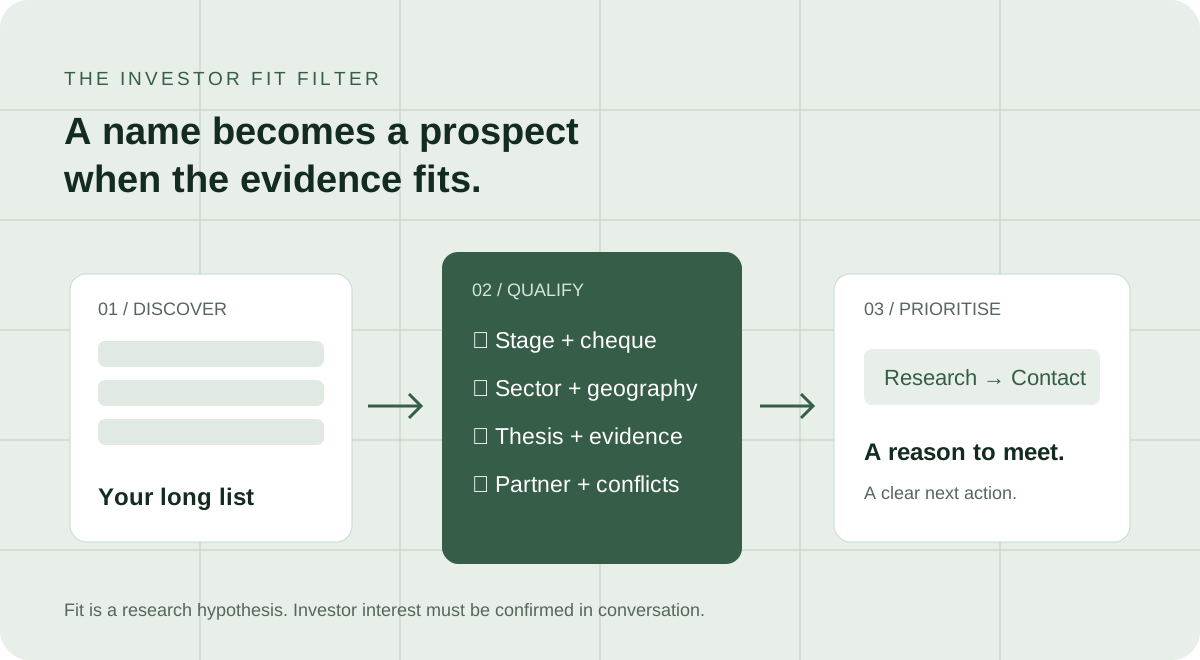
Keep three groups: ready to approach, needs research and parked. A strong fit with verified facts belongs in the first group. A promising candidate with missing facts belongs in the second. A known mismatch belongs in the third, with a short reason.
Within the first group, consider the partner’s relevant experience, potential round role, and whether you have a credible introduction path. When asking for an introduction, explain the fit and let the contact decide whether they are comfortable making it.
Write a specific next action: “Ask our adviser whether they know the software partner” is useful. “Follow up sometime” is not. You can also use a concise direct approach when the investor provides a channel for it.
There is no magic shortlist length. Start with a batch you can research and contact thoughtfully. Expand it as you learn which investors fit, what objections recur and which assumptions need revisiting. The quality of the evidence matters more than hitting an arbitrary number.
How to use VCLab to build your investor list.
The Founders’ Stack brings investor discovery and outreach into one workflow. VCLab’s directory contains 27,000+ investor records. Start with your fundraising profile, review the fit behind each result, then organise your next action in FundLab.
The steps below show how the full tool works. You can try a ten-investor preview directly beneath them.
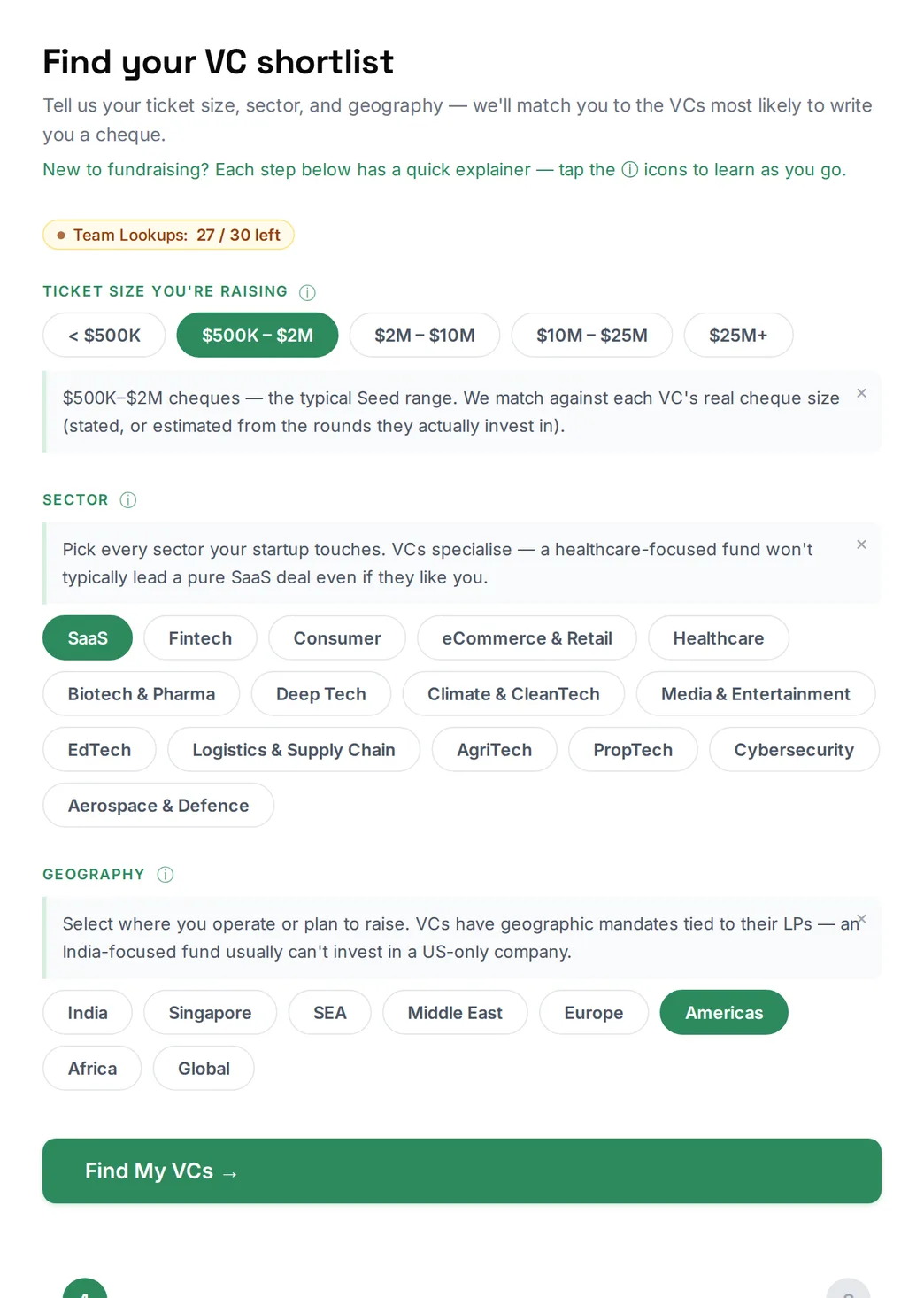
1. Set your fundraising profile.
Open VCLab and choose your ticket size, sector and geography. These choices narrow the starting list so you can spend your time checking relevant candidates.
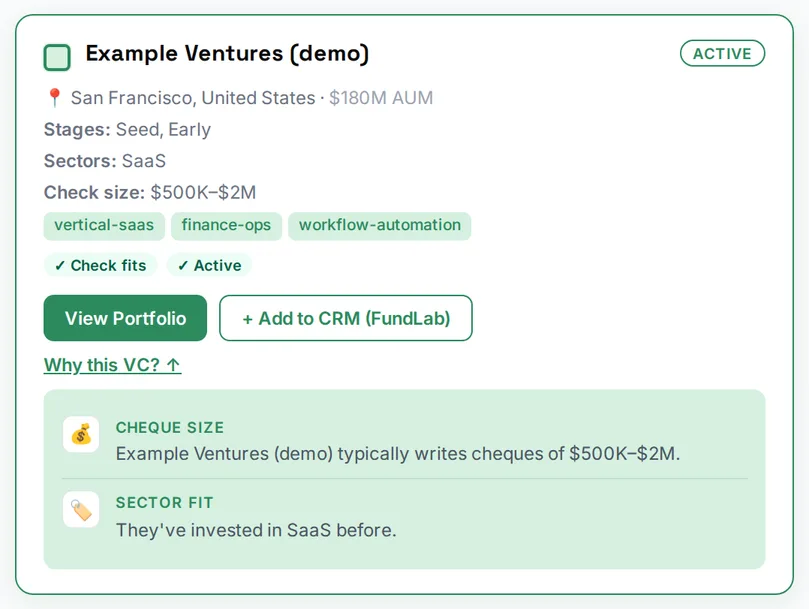
2. Review the reason for each match.
Read the investor’s stage, sectors and stated cheque size, then open “Why this VC?” to understand the fit. Verify the firm’s current mandate, relevant partner and portfolio conflicts before reaching out.
3. Turn the shortlist into a next action.
In the full tool, review a fund’s portfolio and add qualified candidates to FundLab to organise outreach. In this free preview, save up to ten candidates and download a branded Excel shortlist after creating an account.
Try VCLab here: find your first ten candidates.
Enter the amount you are looking to raise, then choose your sector and geography. Two cards are visible immediately; a free account reveals the rest and lets you download the complete shortlist. The full tool depends on your account and plan.

Find your investors.
Your potential investors
Enter the details to see what this preview can help you work through.
Reveal your shortlist.
Create a free account or log in to view and save the result. No payment required.
Continue with the complete workflow in VCLab.
Explore VCLab →Your shortlist checklist
Before moving an investor into outreach, check whether you can answer these questions. Keep a missing answer as an explicit research task.
- I can explain our round, progress and requested cheque.
- I have checked stage, sector and geographic fit.
- I have separated a stated cheque range from an estimate.
- I know which partner may be relevant and why.
- I have reviewed portfolio overlaps and noted possible conflicts.
- I have evidence of activity and will confirm new deal appetite.
- I have recorded sources, dates and unanswered questions.
- I have written one next action with an owner and date.
The CSV opens in Excel or Google Sheets. It includes the research fields above and one clearly labelled fictional example you can replace.
Sources and further reading
This guide presents our practical research framework. These readings offer broader context; the fictional brief, comparison and checklist are illustrative.
- Y Combinator: A guide to seed fundraising — context on preparing for a raise and investor conversations.
- Founders’ Capital: The Data-Driven Blueprint for Your Next Funding Round — our earlier investor-targeting article. This guide focuses on qualification and evidence; it does not use that article’s market statistics or conversion estimates.
Next in the Fundraising Library
Monthly investor update template: what to include, with an example →
Keep your investors informed with comparable numbers and a clear ask.