
How do SAFE caps and discounts affect conversion?
A valuation cap sets a cap-based conversion price; a discount reduces the price paid by new investors in the priced round. Divide the SAFE investment by the applicable price to get conversion shares. Then divide those shares by the complete share total to get ownership.
For the YC US cap-only form, compare cap-based shares with shares at the new investors’ price and use the larger share count. The separate discount-only form uses the discounted round price. If an agreement expressly contains both terms, read how it chooses between them; do not apply a discount to the cap price by default.
This guide explains an equity-financing conversion using the YC US post-money form family available on 3 October 2026. The examples are fictional, in USD, for a US corporation. They do not model an acquisition, dissolution, tax outcome or another jurisdiction’s instrument. Use the signed agreement and counsel’s closing calculation for a real transaction; this is an educational worksheet, not legal or investment advice.
The useful question is not only “what does the SAFE convert at?” It is also “which shares count before conversion, and what is added afterwards?”
1. Start with the actual instrument.
Record the document title, date, company jurisdiction, purchase amount and any amendments or side letters. “SAFE” is a category, not enough information to calculate conversion.
| Form | Term to record | Conversion review |
|---|---|---|
| Valuation cap, no discount | Post-money valuation cap | Compare cap-based shares with shares at the round price. |
| Discount, no valuation cap | Discount Rate | Round price × Discount Rate. |
| Uncapped MFN | Applicable later documents and any amendment | Resolve the terms actually adopted before modelling. |
These are separate downloads. A 20% discount corresponds to an 80% Discount Rate in the YC discount form. Confusing those labels changes a $1.00 price from the intended $0.80 to $0.20. See the discount-only form, sections 1(a) and 2.
The YC user guide, Appendix I, also discusses a cap-and-discount alternative. The current US download list does not offer that as one of its three listed forms. Our combined example below is an explicit hypothetical agreement with a lower-price rule; it is not presented as the current standard YC form.
Do not substitute a pre-money SAFE, a convertible note, a Singapore SAFE or a CARE and retain the same assumptions. Their terms need their own review. The official YC page lists jurisdiction-specific forms separately.
2. Define which shares the cap divides by.
The US post-money cap form’s Safe Price is the cap divided by its defined Company Capitalization. This includes converting securities, including that SAFE, as well as outstanding shares, options, promised options and the existing unissued pool, without double counting. A financing-related pool increase has a specific exception for promised options. See the cap-only form, section 2.
That means the denominator can contain the very SAFE shares you are calculating. You must solve that relationship; dividing a post-money cap by only the founders’ existing shares misses it.
Post-money with respect to the SAFE raise is not post-money with respect to the next priced round. An investment/cap ratio, when the cap route applies, describes ownership on the SAFE’s capitalization basis. Later new-money shares and a financing pool increase can dilute it. It is not a permanent final percentage. YC’s user guide, pages 3-4 and conversion Q&A.
Separately, ask how the priced round’s share price is set. Does the negotiated pre-money capitalization include conversion shares? Does it include a pool top-up? A cap quotation and a round valuation may use different share totals. Compare actual prices per share, not just headline valuations.
3. Work through one SAFE from price to ownership.
Fictional company: Cedar Labs. It has 9,000,000 founder common shares and one $500,000 SAFE. No other investors, notes, warrants, options, promised options or unissued pool exist. No pool is added at financing. No pro rata purchase, secondary sale or fee issues shares. Fractional shares are retained for illustration; actual closing rounding is outside this model.
The priced round sells new preferred shares at a fixed $1.00 per share and raises $2,000,000 of new money. We compare three alternative instruments for the same $500,000, not three SAFEs stacked together. Keeping the round price fixed means the implied pre-money valuation changes with conversion shares; we are not holding both price and pre-money valuation constant.
The cap-only alternative: $5,000,000 post-money cap
Let x be the SAFE conversion shares. On the cap route, Company Capitalization is 9,000,000 + x. Therefore:
x = $500,000 ÷ [$5,000,000 ÷ (9,000,000 + x)]
x = 900,000 + 0.10x
x = 1,000,000 shares; Safe Price = $0.50.
The competing round-price route gives $500,000 ÷ $1.00 = 500,000 shares. The cap-only form selects the greater share count: 1,000,000. Immediately after conversion and before new money, the SAFE owns 1,000,000 ÷ 10,000,000 = 10%.
New money then buys $2,000,000 ÷ $1.00 = 2,000,000 shares. After financing there are 12,000,000 shares: founders own 75%, the SAFE holder 8.3333%, and new investors 16.6667%. The $1.00 round price implies $10M pre-money including conversion shares and $12M post-money on this agreed basis.
The discount-only alternative: 20% off
The discount price is $1.00 × 80% = $0.80. The SAFE converts into $500,000 ÷ $0.80 = 625,000 shares. With the same 2,000,000 new-money shares, total shares become 11,625,000. The SAFE owns 5.3763% after financing. The implied pre-money is $9.625M, not the cap-only case’s $10M.
| Alternative | Conversion price | SAFE shares | SAFE after financing |
|---|---|---|---|
| $5M post-money cap only | $0.50 | 1,000,000 | 8.3333% |
| 20% discount only | $0.80 | 625,000 | 5.3763% |
| Hypothetical combined terms | $0.50 | 1,000,000 | 8.3333% |
The hypothetical combined agreement expressly uses whichever route gives more shares: the cap route or the 20%-discount route. Here the cap route wins. It does not discount $0.50 by another 20%. That would create $0.40 and a different result unsupported by our assumed clause.
4. Change the round price and compare the routes.
This local worksheet uses Cedar’s exact assumptions. It compares three alternative single-instrument cases. The combined case is hypothetical. Inputs and results stay in this page; no account, upload or saved company record is required.
To see the discount win in the hypothetical combined case, keep the other defaults and enter a round price of $0.40. Its 20% discount gives $0.32, below the cap-route candidate of $0.50. The cap-only case instead uses the $0.40 round price. At $0.625, the combined case’s routes tie at $0.50.
Show the worksheet’s calculation method
For one SAFE, investment A, cap C and existing shares S, the cap-only route solves x = A(S+x)/C, giving x = AS/(C−A), with C > A. The round route gives A/P shares at new-money price P. Cap-only uses the larger of those two counts. Discount-only uses A/[P(1−d)], where d is the discount as a decimal. Our hypothetical combined case uses the larger of the cap-route and discount-route counts.
After selecting x, the full total is S + x + N/P, where N is new investment. The implied pre-money is P(S+x). No option pool, other converting security, MFN, interest or pro rata purchase is modelled. The cap-route price displayed is a comparison candidate; when another route wins, the cap divided by actual Company Capitalization can differ.
5. Carry the calculation through the whole round.
A correct conversion share count can still produce an incomplete ownership answer. Include all the equity issued at closing, then reconcile the denominator and check that ownership totals 100% on the stated basis.
- Multiple SAFEs: record each form, cap, discount and amendment. Converting securities can interact through capitalization; do not treat each as an isolated Cedar example and add its final percentages.
- Option pool: identify the existing pool, promised awards, the increase and its timing. A new pool target expressed as a post-round percentage may require another equation. Do not enter “10%” without saying 10% of which total.
- Pro rata: a right to participate is not itself another investment. Add the holder’s actual follow-on purchase only if exercised and funded under the round assumptions.
- Round pricing: if the term sheet fixes a pre-money valuation rather than a share price, determine how converting securities and the pool enter its denominator. The worksheet above fixes price and derives pre-money.
- Final record: distinguish a proposed scenario from issued shares, and reconcile the closed round against the signed documents and final share ledger.
In Cedar, the SAFE’s pre-new-money 10% becomes 8.3333%. That is a fall of 1.6667 percentage points, or 16.6667% relative dilution. The holder still has the same 1,000,000 shares after new money arrives. Read the founder dilution guide if those two measures are easy to mix up.
Review the inputs in TermLab and the ownership journey in CapLab.
TermLab’s SAFE section currently provides fields for the priced-round assumptions, individual SAFE terms and comparisons. CapLab can record a pending SAFE and a subsequent priced round. The screenshots below are existing fictional product demonstrations; they show input locations, not Cedar’s verified closing result.
- Collect the terms first. Open TermLab and find SAFE conversion. Record the new-money assumptions, fully diluted starting shares and pool separately. Keep a note of the signed pricing denominator alongside the inputs.
- Choose the actual instrument. Add each SAFE with its purchase amount and applicable type. Enter a cap only for a capped instrument. Check discount field conventions: the current tool uses the discount off the price, whereas the YC document’s Discount Rate is the remaining percentage. Leave the note/interest option off for a plain SAFE.
- Review rather than assume. Compare scenarios and keep the input snapshot with the source documents. Carry a pending instrument into a proposed sequence in CapLab, and reconcile conversion shares and the complete table before relying on a result.
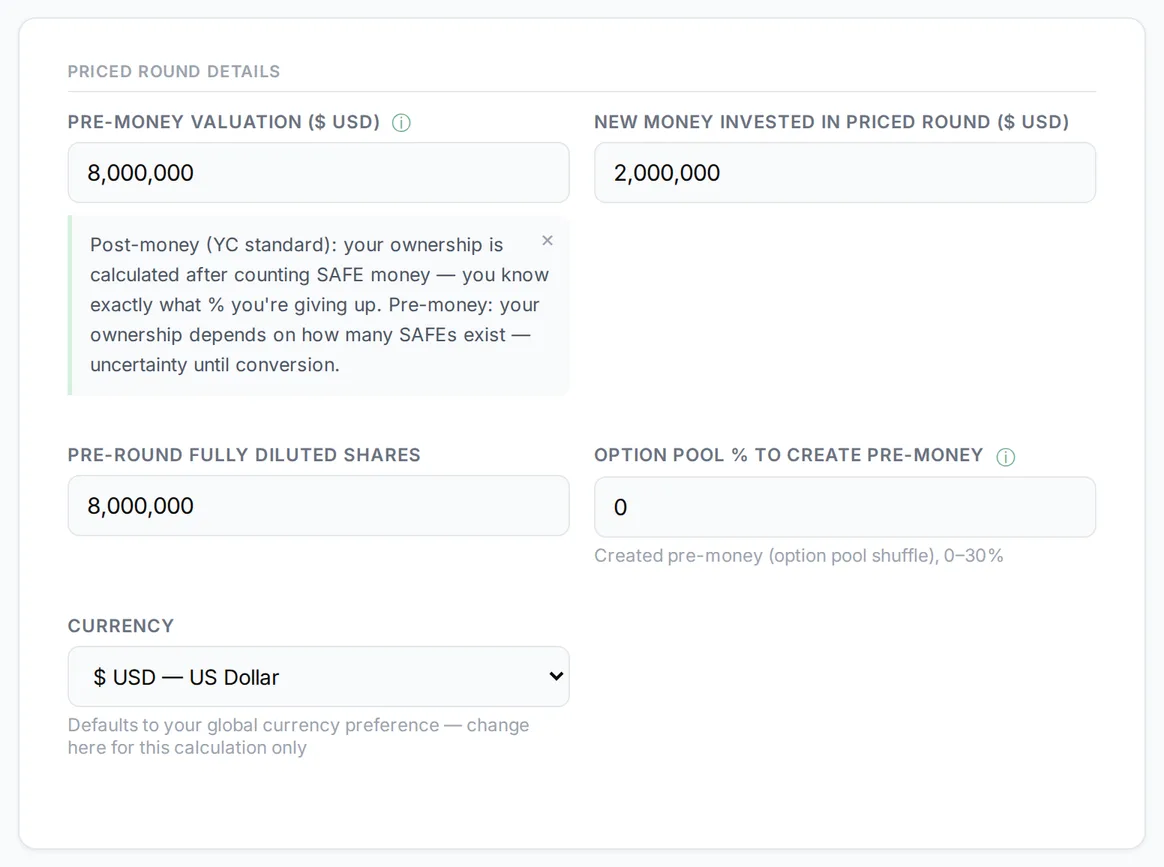
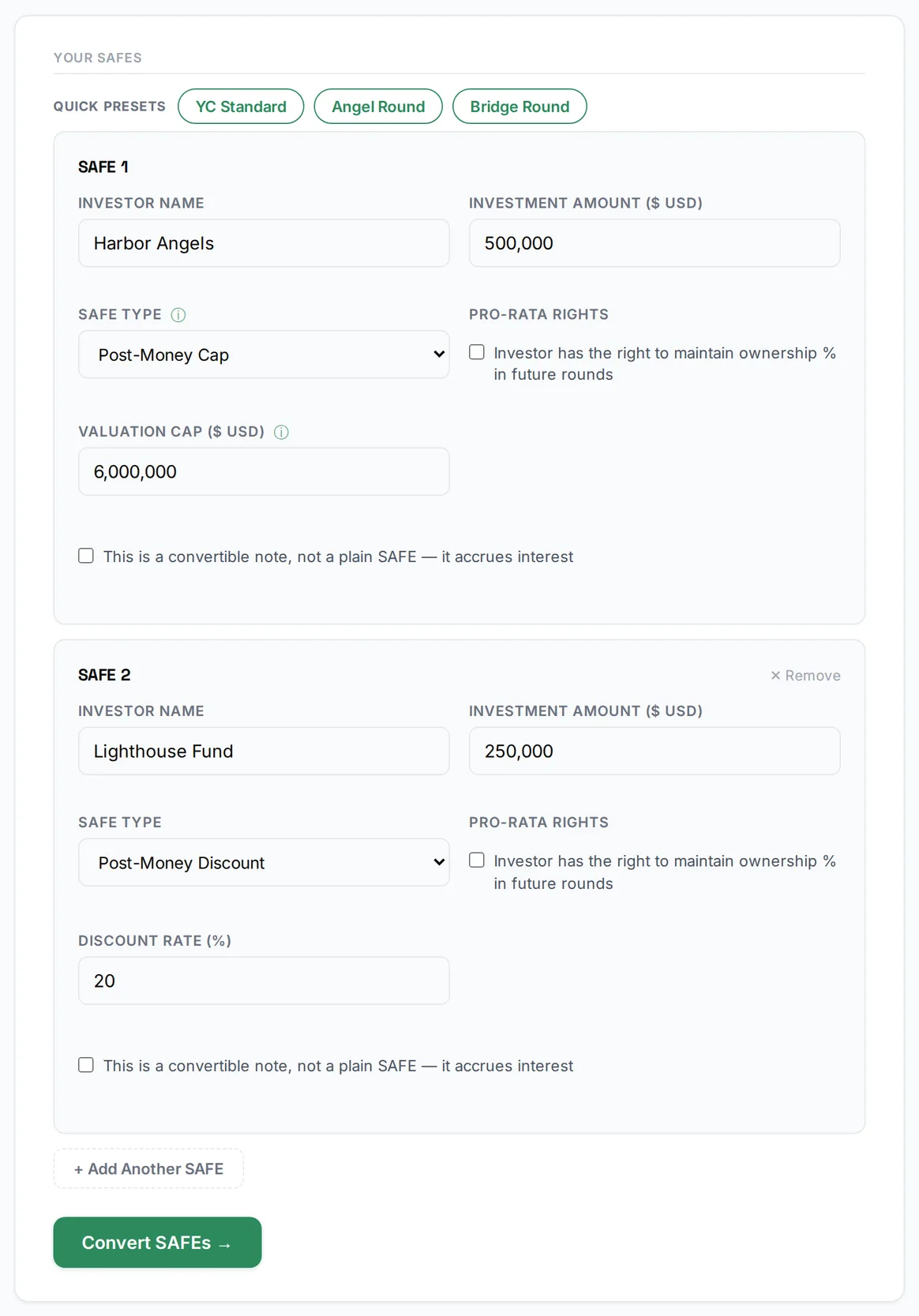
Calculation scope matters. The current shared SAFE calculator uses a simplified capitalization model. Its post-money cap denominator does not reproduce the converting-share denominator used in Cedar’s YC example. The walkthrough demonstrates recording and reviewing inputs; its conversion output is not verified against your signed instrument. Use the independently defined worksheet above to understand this single-SAFE case, and reconcile a real closing model with counsel.
The article and worksheet are public. The product overview describes results as requiring a free account; saved scenarios and full-tool access follow your current account permissions. Check current access and allowances before starting a full workflow. No tool inputs are submitted by this article’s comparison.
Before you use a conversion result.
0 of 7 reviewed
Checking these boxes records your review of the assumptions; it does not verify an agreement or complete a transaction.
Common questions about SAFE conversion.
Does a cap value my company today?
A cap is a contractual conversion term. It is not, by itself, an appraisal, an agreed priced-round valuation or evidence of what someone will pay for the company.
Can I multiply the cap by 80% to apply a 20% discount?
Only if your actual agreement says that is the calculation. The YC discount-only form discounts the new investors’ share price. Our hypothetical combined case compares routes instead of stacking the discount on the cap.
Will a $500,000 SAFE at a $5M post-money cap always own 10%?
No. Ten percent describes the cap-route ratio on the relevant capitalization basis. A sufficiently low round price can give more conversion shares; financing shares and a pool increase can then reduce the final percentage. In Cedar’s cap case it is 10% before new money and 8.3333% afterwards.
Does a SAFE holder own issued shares when the money arrives?
The SAFE is a right to future shares under its terms. Record it as an outstanding instrument until the relevant conversion event. An expected percentage in a planning table is not the same as issued stock.
What if there is never a priced round?
This worked example does not answer that outcome. Read the agreement’s other events and termination provisions. The cap and discount conversion worksheet is not an exit waterfall or a repayment forecast.
Can I use these numbers for a Singapore company?
The arithmetic is illustrative, but this guide’s instrument definitions are scoped to the US forms. Use the appropriate signed Singapore instrument and confirm its terms, capitalization and local requirements with counsel.
Sources and further reading.
Primary documents checked 3 October 2026. Cedar Labs, its numbers and the interactive comparison are our own fictional illustrations.
- YC official SAFE page and current form list · US variants and separate non-US forms.
- YC US post-money SAFE: valuation cap, no discount · sections 1(a) and 2, conversion and Company Capitalization.
- YC US SAFE: discount, no valuation cap · Discount Rate and Discount Price.
- YC post-money SAFE user guide · post-SAFE versus post-financing ownership, conversion Q&A and Appendix I.
- Ashish’s Founders’ Capital essay on SAFE mechanics · a companion perspective on modelling the next round. This guide supplies its own explicit assumptions and independent math.
- TermLab overview and CapLab overview · product context. Screenshots show fictional demonstrationnstration inputs; the calculation limitation is stated above.