
State which side of the investment the valuation describes.
Pre-money valuation describes the company immediately before the new investment. Post-money valuation describes it immediately after. In a simple priced round with only new primary investment at one share price, post-money = pre-money + new investment. The new investor’s ownership is investment ÷ post-money.
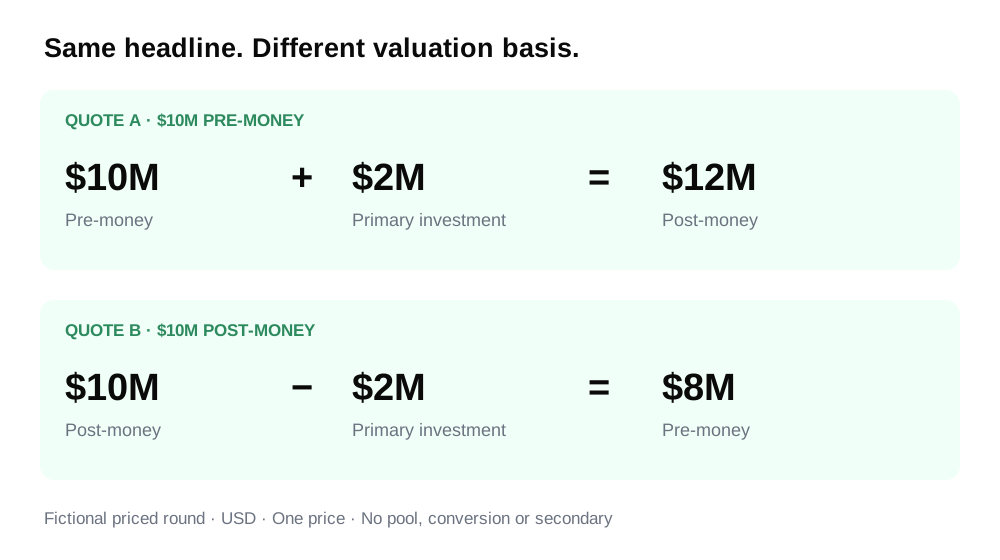
A $2 million investment at $10 million pre-money means $12 million post-money and about 16.67% investor ownership. A $2 million investment at $10 million post-money means $8 million pre-money and 20% ownership. The same headline number describes different terms.
This guide helps you translate the quote, trace the shares and compare two offers on the same basis. It does not estimate what your company should be worth. All Northstar names and numbers are fictional; the examples exclude pools, converting instruments, fees, secondary purchases and other issuances.
Carta’s simple-financing example demonstrates why investor ownership uses the post-money denominator. The calculations here use our own fictional terms and starting shares.
1. Translate the quote before comparing it.
Ask what the number includes. “We are raising $2 million at a $10 million valuation” leaves the valuation basis unstated. It also leaves open whether the $2 million is the whole round or one investor’s contribution. Those details change the ownership calculation.
| Term | Meaning in this example | Relationship |
|---|---|---|
| Pre-money | Negotiated equity valuation before this investment. | Post-money − primary investment |
| Post-money | Equity valuation after this investment. | Pre-money + primary investment |
| Investor ownership | New shares as a share of the post-round total. | Primary investment ÷ post-money |
| Price per share | Price used for the new shares. | Pre-money ÷ agreed pre-round share count |
For a $2 million round, “$10 million pre” and “$12 million post” describe the same simple valuation. “$10 million pre” and “$10 million post” do not. Put both numbers beside the proposed investment so the comparison is unambiguous.
2. Trace the same company through both quotes.
Northstar Cloud, Inc. begins with 8,000,000 shares. Maya holds 4,800,000 (60%) and Leo holds 3,200,000 (40%). There are no other equity claims in this teaching example. Summit Ventures invests the entire $2,000,000 round in newly issued shares.
Quote A: $10 million pre-money.
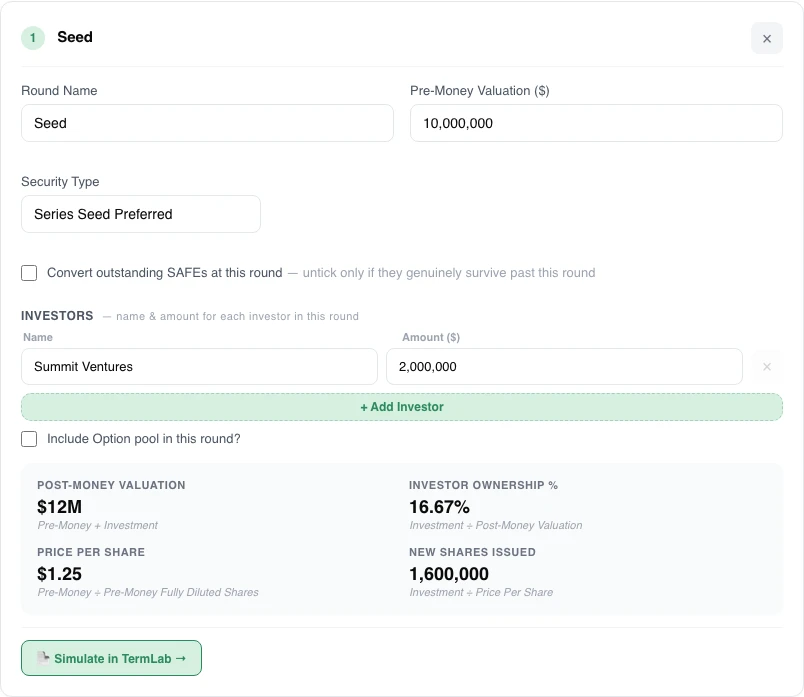
Price per share = $10,000,000 ÷ 8,000,000 = $1.25. Summit buys $2,000,000 ÷ $1.25 = 1,600,000 new shares. Total shares become 9,600,000. Summit owns 1,600,000 ÷ 9,600,000, or about 16.67%.
Quote B: $10 million post-money.
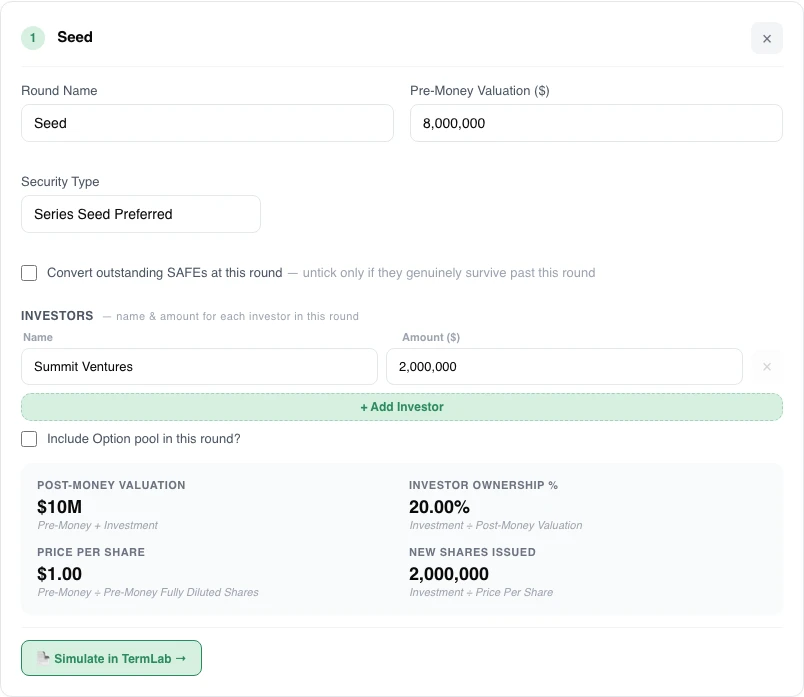
First subtract the $2,000,000 investment: pre-money is $8,000,000. Price per share = $8,000,000 ÷ 8,000,000 = $1.00. Summit receives 2,000,000 new shares and owns 20% of the 10,000,000 post-round shares.
| Measure | Quote A: $10M pre | Quote B: $10M post |
|---|---|---|
| Pre-money | $10,000,000 | $8,000,000 |
| Post-money | $12,000,000 | $10,000,000 |
| Price per share | $1.25 | $1.00 |
| New investor shares | 1,600,000 | 2,000,000 |
| Total shares after | 9,600,000 | 10,000,000 |
| New investor ownership | 16.67%, rounded | 20.00% |
The founders keep the same number of shares in both cases. Their percentage changes because the company issues a different number of new shares. Select a quote to inspect its ownership table; both complete numerical cases are in the download.
Quote A: $10M pre-money + $2M investment = $12M post-money. Summit owns 16.67%, rounded.
| Holder | Shares after | Ownership before | Ownership after |
|---|---|---|---|
| Maya Rao | 4,800,000 | 60.00% | 50.00% |
| Leo Chen | 3,200,000 | 40.00% | 33.33% |
| Summit Ventures | 1,600,000 | 0.00% | 16.67% |
| Total | 9,600,000 | 100.00% | 100.00% |
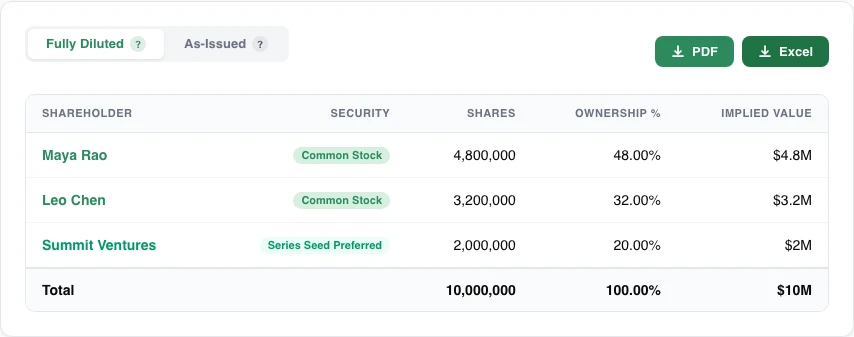
At Quote B, Maya owns 48% and Leo owns 32%. Relative dilution is the investor’s 20% in this simple round; Maya’s drop is 12 percentage points and Leo’s is 8. The founder dilution guide explains that distinction in more detail.
3. Reconcile the share count behind the valuation.
The price formula needs an agreed capitalization denominator. List what the pre-round count includes: issued shares, reserved or granted options, warrants and instruments converting in the financing. Document the treatment of any pool increase. In our example, the issued and fully diluted counts both equal 8,000,000 because nothing else exists.
Carta’s cap-table guide distinguishes issued and outstanding shares from a fully diluted view. For an actual transaction, use the capitalization definition in the agreed documents, then reconcile every modeled security to that definition. A label in a spreadsheet does not settle a contractual ambiguity.
Splitting the same pre-round ownership into more shares changes the price per share, while leaving the ownership result unchanged under otherwise identical terms. For example, twice as many starting shares at the same pre-money valuation means half the price per share and twice as many new shares. Share count and price must be checked together.
Separate valuation from cash in the bank. A $12M post-money valuation does not mean Northstar has $12M cash. The company receives $2M of gross investment in Quote A. Existing cash, fees and other cash movements belong in the cash reconciliation. The valuation also does not promise that each holder could immediately sell their shares for that amount.
4. Identify what the simple formula leaves out.
| Additional term | What to clarify |
|---|---|
| Option pool | Current reserve, proposed increase, target denominator and timing relative to the investment. |
| SAFEs or notes | Instrument version, conversion terms and which shares enter the capitalization calculation. |
| Secondary purchase | Money paid to an existing holder versus new primary capital paid to the company. |
| Several investors or closings | Total primary round amount, share prices and the point at which ownership is measured. |
| Rights and fees | Security class, preferences, governance rights and gross versus net company proceeds. |
A secondary transfer alone moves existing shares between holders; it does not create the new shares in this example. If a package includes both primary and secondary money, separate the components before applying the primary-investment formula.
A post-money SAFE cap has its own meaning. YC’s post-money SAFE user guide explains that its cap is post the SAFE money, rather than post the later priced-round money. Do not enter a SAFE cap as this priced round’s post-money valuation. Conversion requires the actual instrument terms.
Compare the full economics once those terms are known. A higher headline valuation alone does not tell you whether one package better supports the company’s plan or how different rights affect an exit. Document unresolved terms instead of treating the simplified percentage as a final transaction model.
Review both quotes in CapLab.
These screenshots show the current CapLab interface with fictional Northstar inputs supplied locally. A fictional paid UI state permits the capture; autosave and service writes were disabled. Calculations ran in the actual page. No real account, saved scenario, export or live registry change occurred.
For your own work, the full Scenarios & Simulator workflow requires sign-in and the relevant plan access. Keep a proposed transaction in a scenario and review it before using any action that promotes it to the live record.
Enter the translated pre-money figure.
Start with 8,000,000 shares, Maya’s 4,800,000 and Leo’s 3,200,000. Use USD throughout. Add a Seed round with Summit’s $2,000,000 primary investment and no option pool or converting instruments. The round’s input is labelled Pre-Money Valuation.
Translate a post-money quote before using that same field.
For Quote B, subtract the $2M primary investment from $10M post-money. Enter $8M pre-money in the round. Entering $10M in that field would model Quote A instead.
Reconcile the ownership output.
Check founder shares, new investor shares, the share total and ownership basis. Fully Diluted and As-Issued match for this stripped-down example. The output’s “Implied Value” applies the financing valuation; it is not realized sale proceeds. Keep the chosen terms and their version with any saved scenario or exported review file.
Use the existing CapLab preview for a simple round.
Enter two founders whose starting ownership adds up to 100%, a pre-money valuation and one new investment. For Quote A, use USD, 60%, 40%, 10,000,000 pre-money and 2,000,000 investment. For Quote B, enter 8,000,000 pre-money with the same investment. Translate a post-money quote before entering it.
A free account is required to view and save your result. This preview saves one scenario that you can revise. It excludes option pools, earlier investors, SAFEs, notes, fees and secondary sales. When signed in, running the preview sends your inputs to the platform. Signed-out submission first displays the account gate.
Your result
Enter the details to see what this preview can help you work through.
Your inputs are ready.
Create a free account or log in to view and save the result. No payment required.
Continue with the complete workflow in CapLab.
Explore CapLab →Before quoting the valuation or comparing offers.
Selections record your review on this page and reset on reload. They do not verify documents or save a transaction.
0 of 7 reviewed
Copy a valuation clarification note
COMPANY / TERMS VERSION: Replace with the company and reviewed terms
CURRENCY: State one consistent currency
PRIMARY ROUND AMOUNT: State the total new company investment
QUOTED VALUATION / BASIS: State amount and pre-money or post-money
TRANSLATED PRE / POST: Record both values under the stated assumptions
CAPITALIZATION: Record share count and included securities
SECONDARY / FEES: Record separately from primary investment
POOL / CONVERTIBLES: Describe treatment or explicit exclusion
PRICE / SHARES / OWNERSHIP: Reconcile the resulting table
OPEN TERMS / OWNER / DATE: Name each issue to resolve
Copy the structure, then add your reviewed terms.
Common questions
Is $10M pre-money the same as $10M post-money?
With positive primary investment in the simple round, no. At $2M investment, $10M pre means $12M post, while $10M post means $8M pre. Compare the translated amounts and the full terms.
Do I divide the investment by pre-money to get ownership?
No. In this simple priced round, divide by post-money. $2M ÷ $10M pre = 20% is the investment-to-pre-money ratio; it is not the investor’s post-round stake at that quote. The stake is $2M ÷ $12M, about 16.67%.
Does the post-money figure tell me cash available?
No. It is a financing valuation. Reconcile the actual cash received, existing cash, fees and payments separately.
What if several investors join the same round?
For this one-price example, use total primary investment when calculating post-money. Each investor’s investment divided by that same post-money value gives its stake, under the stated exclusions. Different prices, conversions or later closings require the complete share schedule.
Does a higher valuation make an offer better?
The headline alone cannot answer that. Review the amount and timing of capital, ownership, rights, obligations and the operating plan. These examples explain the calculation; they do not recommend a valuation or an offer.
Sources and further reading
Reviewed on 3 October 2026. Our fictional examples and clarification worksheet supply the worked arithmetic. This guide addresses a simple priced round; transaction documents govern actual securities and their rights.
- Carta: The life of a cap table, 22 December 2016. Used only for the simple-financing denominator discussion, not its separate liquidation illustrations.
- Carta: What is a cap table? Used for capitalization terminology; no market benchmarks or universal pool assumptions used.
- Y Combinator: Post-money SAFE user guide, v1.1, pages 3–4 of the PDF. Used to distinguish the SAFE-cap basis from the subsequent priced financing.