
An employee option pool reduces founder ownership on a fully diluted basis when the reserve is created or enlarged. If the pool is included in the shares used to price a funding round, existing holders bear its dilution. If it is added after the investment, the new investor is diluted too. To compare offers, specify both when the pool enters the calculation and what share total its percentage refers to.
A term such as “10% pool” leaves an important question unanswered: 10% of which capitalization, and how much of that pool must still be available for future grants? This guide traces the shares through one fictional priced round and then separates a grant from a later pool increase.
This is an educational ownership model. It excludes SAFEs, notes, warrants, secondary sales, fees and special financing rights. The approved plan and transaction documents determine the actual capitalization and grant rules.
1. Define the reserve before negotiating its size
An option reserve sets aside capacity for equity awards. An unallocated reserve is not an employee who already owns or votes shares. For the examples here, fully diluted (FD) means founder shares, investor shares, outstanding granted options and the remaining unallocated reserve, counted once each.
The total pool includes the granted and still available parts. The available pool excludes options already granted. A request for “10% available after closing” can therefore require a larger total pool than “10% total after closing.” Read the definition in the proposed terms.
Cooley GO explains that a financing can specify an available pool as a percentage of post-closing FD capitalization while including those shares in the pre-closing price calculation. Its discussion concerns US venture financings; use the signed definitions for your own transaction. Source: Cooley GO, Negotiating the Option Pool.
“When is the pool included?” controls who bears dilution. “What is the denominator?” controls how many shares are reserved. A post-closing percentage does not necessarily mean the pool is created after the investment.
2. Build the pool from a hiring plan
List the roles needed to reach your next operating milestone, the expected hiring dates, proposed grants and retention or refresh awards. State one common FD denominator for percentage estimates, then translate them into shares. Check the available reserve against that budget.
For a fictional team, a share budget might assign 180,000 options to engineering hires, 90,000 to a sales hire and 90,000 to refresh awards, plus a separately explained 90,000 contingency. The total is 450,000 options. These are illustrative allocations, not compensation benchmarks.
If the available reserve is 450,000, that budget uses all of it. If the available reserve is smaller, discuss a top-up, a smaller hiring plan or revised grants. Carta recommends sizing around planned hires and refresh awards. Source: Carta, option-pool guide.
Make the hiring horizon fit the operating plan rather than assuming a universal percentage. Document uncertain hires separately so the proposed buffer can be discussed.
3. Compare the same 10% final pool under two timings
Fictional example: Northstar Cloud, Inc. starts with 6,300,000 founder shares: Maya owns 3,780,000 and Leo owns 2,520,000. Summit invests $2,000,000 at an $8,000,000 pre-money valuation. There is no existing pool and no other equity claim. The two pool cases target a reserve of 10% of final FD shares, all unallocated at closing.
Without a pool, founders retain 80% and Summit owns 20%. Final FD shares: 7,875,000.
| Holder or reserve | Final FD shares | Final ownership |
|---|---|---|
| Maya Rao | 3,780,000 | 48.00% |
| Leo Chen | 2,520,000 | 32.00% |
| Summit Ventures | 1,575,000 | 20.00% |
| Unallocated reserve | 0 | 0.00% |
| Total | 7,875,000 | 100.00% |
The controls compare fixed public examples. No account or personal inputs are needed. With JavaScript unavailable, the baseline and both calculations below remain readable.
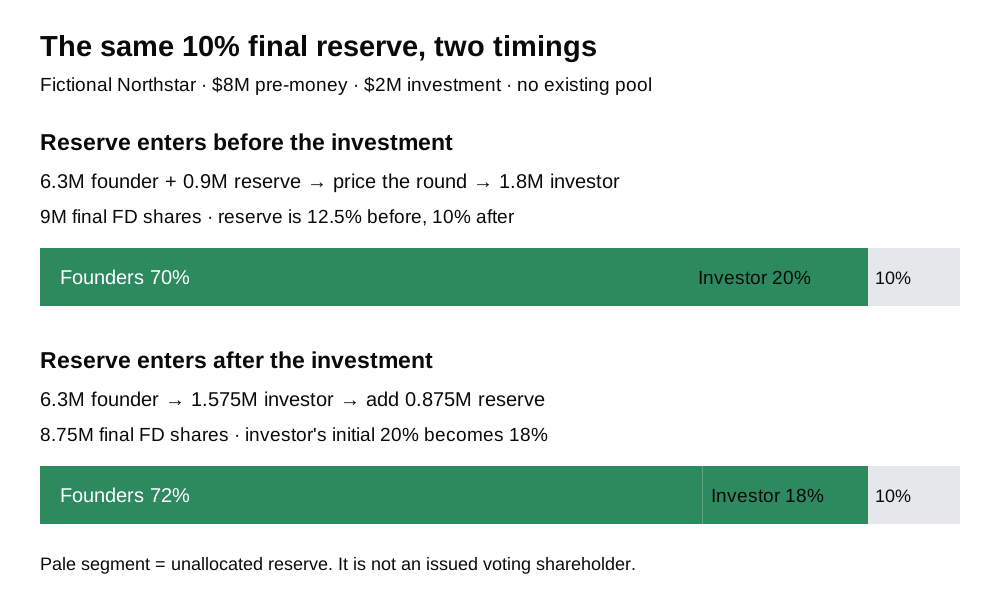
Pool included before investment: founders retain 70%
Add 900,000 reserve shares before pricing. The pre-round FD total becomes 7,200,000. Price per share is $8,000,000 ÷ 7,200,000, approximately $1.111111. Summit receives 1,800,000 shares. Final FD shares are 9,000,000: founders 70%, Summit 20% and reserve 10%.
Maya finishes at 42% and Leo at 28%. Relative to the no-pool baseline, founders give up another 10 percentage points. Summit's percentage stays at 20% because the reserve was included in the financing price.
Pool added after investment: founders retain 72%
Price the round first using 6,300,000 founder shares. Price per share is $8,000,000 ÷ 6,300,000, approximately $1.269841. Summit receives 1,575,000 shares. Then add 875,000 reserve shares to the 7,875,000 shares already in the round.
Final FD shares are 8,750,000: founders 72%, Summit 18% and reserve 10%. Maya finishes at 43.2% and Leo at 28.8%. The pool dilutes founders and Summit proportionally: the initial 80% and 20% become 72% and 18%.
The founder difference is 2 percentage points between these two timings. The pool has the same final percentage but different share counts because the financing is priced on different denominators. The price calculations use full precision; do not calculate share issuance from the displayed two-decimal price.
4. Translate the pool percentage into the calculator's basis
For the pre-investment example, 900,000 ÷ 7,200,000 is 12.5% before the financing. After the investor receives 20%, that reserve is 10% of final FD shares.
Pre-round pool percentage = final pool percentage ÷ (1 − investor percentage)
10% ÷ (1 − 20%) = 12.5%
This translation assumes the pool enters the pricing denominator and there are no other equity claims. For the alternative timing, adding a reserve after investment to a fixed share count S uses: new reserve = S × p ÷ (1 − p). Here, 7,875,000 × 0.10 ÷ 0.90 = 875,000 shares.
Entering 10% on a pre-round basis creates 700,000 reserve shares in this example. Summit then receives 1,750,000 shares. Final FD shares are 8,750,000: founders 72%, Summit 20%, reserve 8%. That is a different pool from the 10% final target, even though founders retain 72% in both this case and the post-investment case.
Do not apply these shortcuts unchanged when grants, a prior reserve, convertibles or other investors enter the denominator. Reconcile the complete pro forma instead.
5. Separate grants from a later pool top-up
Return to the pre-investment case: 9,000,000 FD shares, including a 900,000 reserve. Grant 450,000 options from it. The pool now has 450,000 granted and 450,000 available. On our unchanged FD basis, total shares remain 9,000,000 and the total pool remains 10%.
Do not add the grant outside the same reserve and count it twice. Issued-share ownership and FD ownership answer different questions. A grant is also different from vesting or exercise; maintain the separate records required by the plan.
A standalone top-up to 10% available
Suppose Northstar later wants its unallocated reserve to equal 10% of the new FD total, with no concurrent investment or other share changes. Adding 450,000 would miss the target because the denominator grows too.
Additional reserve = (target × current FD shares − available reserve) ÷ (1 − target)
(0.10 × 9,000,000 − 450,000) ÷ 0.90 = 500,000
After the increase, FD shares are 9,500,000. The available reserve is 950,000 (10%), and the total pool is 1,400,000 (14.74%, rounded), including the 450,000 already granted. Founders retain 66.32% and Summit 18.95%, rounded. This calculation is a separate later top-up; it is not the formula for a simultaneous financing.
Cancellations, departures and exercised awards need the approved plan's treatment. Do not assume every departure immediately returns all granted options to the available reserve.
Review the timing with CapLab
Use an account with access to CapLab's builder. Begin with a separate scenario, accurate founder shares and the agreed currency. Keep the reviewed source cap table alongside it. These screenshots use the interface checked on 3 October 2026 with fictional local sandbox data and simulated access; no real account was changed or saved.
- Set Northstar's founder shares to 6,300,000: Maya 3,780,000 and Leo 2,520,000.
- Add one Seed round with $8,000,000 pre-money and Summit's $2,000,000 primary investment. Exclude convertible conversion for this example.
- Enable the pool. For a 10% final reserve included before investment, use the 12.5% pre-round input.
- Review the final fully diluted ownership table: 9,000,000 total, founders 70%, Summit 20%, pool 10%.
- In a separate comparison, select post-investment timing with a 10% pool. Review the final table: 8,750,000 total, founders 72%, Summit 18%, pool 10%.
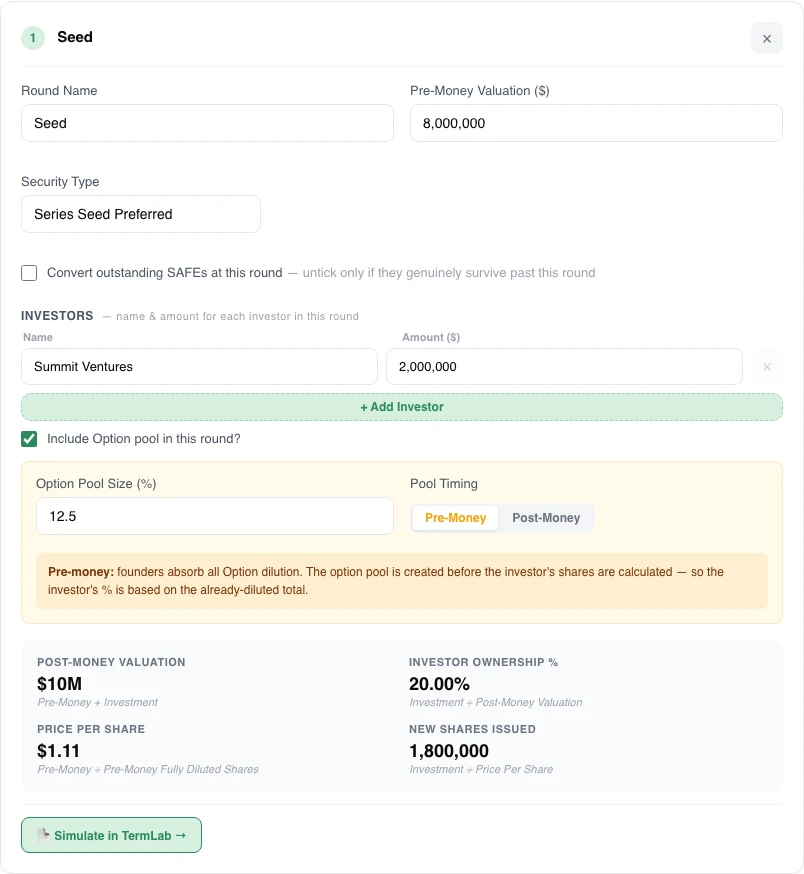
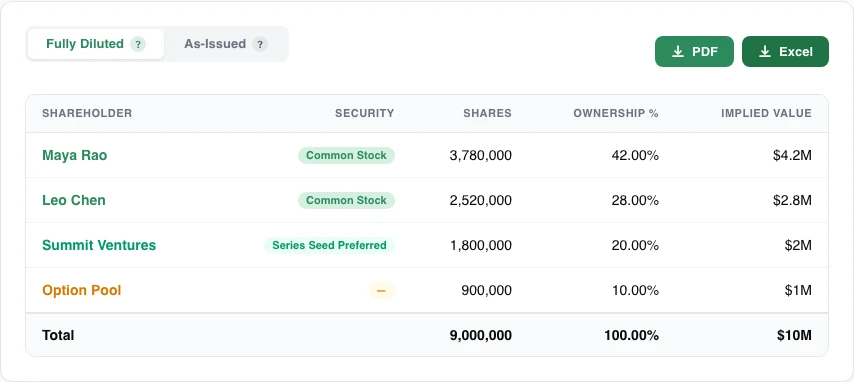
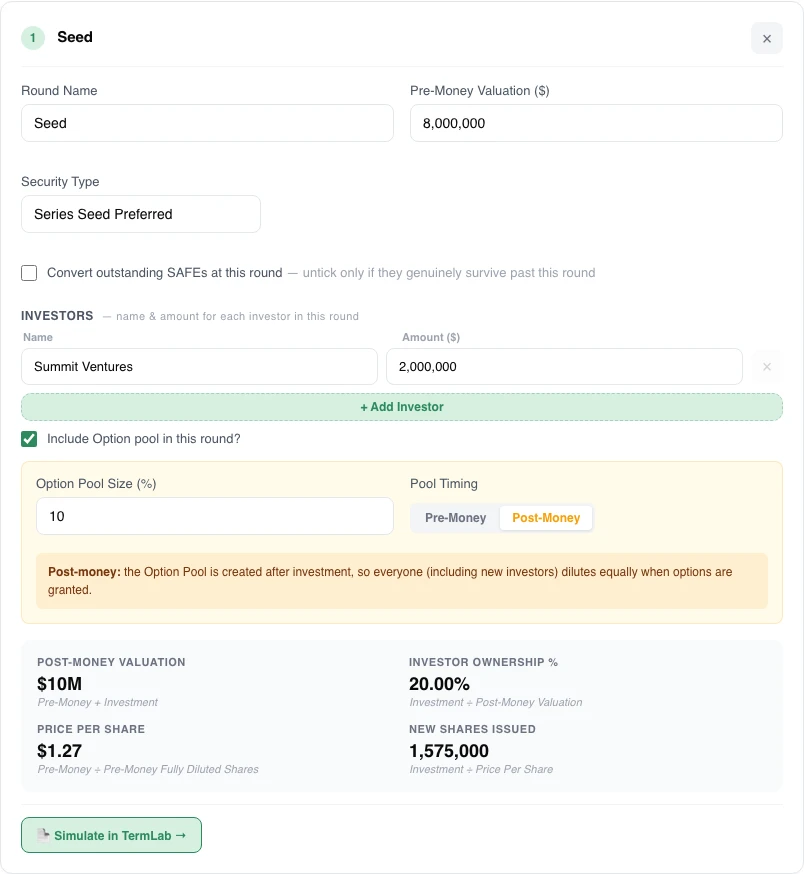
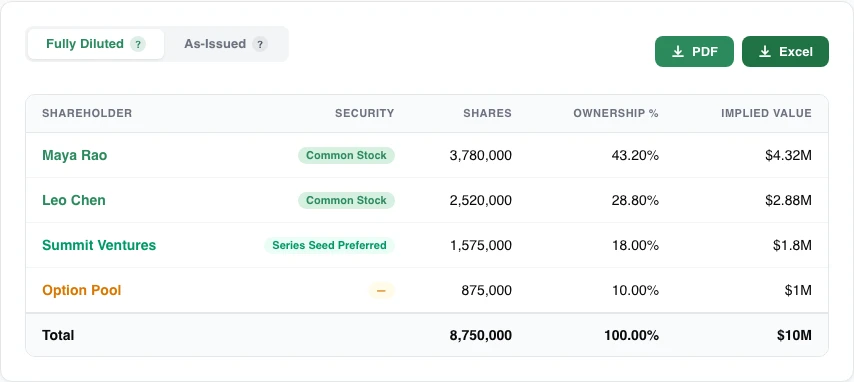
For post-investment timing, the round card's “Investor Ownership %” is investment ÷ headline post-money valuation: 20% here. The final FD table includes the later pool and shows 18%. Also, the current round-level pool input adds a reserve slice; it is not an automatic instruction to top up an existing reserve to a target total. This walkthrough starts with zero reserve. Reconcile existing granted and available capacity before modeling a live top-up.
The post-money helper describes dilution “when options are granted.” In this model, the reserve has already entered the final FD denominator; a later grant within it should not be added again. The pool row is an FD reserve, not cash proceeds or a shareholder with voting rights. CapLab's implied-value column is a modeled allocation, not the fair value of employee options.
Review available capacity with ESOPLab
ESOPLab's Track mode requires an account and a plan. For the fictional pre-investment case, the plan has 9,000,000 FD shares and 900,000 total reserve shares. A single fictional active grant uses 450,000 options. The dashboard shows 450,000 granted and 450,000 available: 50% of the pool used.
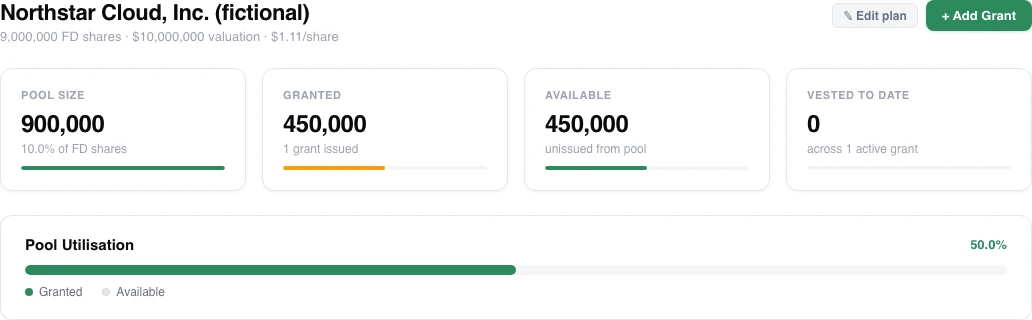
The fixture's grant date is 1 September 2026 with a 12-month cliff; at the capture date, 3 October 2026, vested options are zero. That is a vesting result, not an increase in available reserve. The screenshot was loaded from simulated records; it does not demonstrate a saved plan, CapLab sync or legal grant approval.
Keep the plan's FD total and reserve reconciled with the current cap table. Do not count outstanding grants again as additional reserve. Import or save only reviewed records under your actual account permissions.
The CapLab preview models one simple priced round without a pool. The ESOPLab preview illustrates one grant's vesting schedule. Their results require an account, and signed-in runs send inputs to the platform. Neither preview calculates the pool-timing comparison above; that public comparison stays on this page.
Keep a written record of the pool definition
Copy this structure into your internal review. Fill the blanks from the proposed terms and the approved plan. A sentence stating only the percentage is insufficient.
Pool review note
TERMS / PLAN VERSION:
CURRENCY AND PRIMARY INVESTMENT:
PRE-MONEY VALUATION:
EXISTING FD SHARES AND INCLUDED CLAIMS:
TOTAL EXISTING RESERVE:
GRANTED OPTIONS / AVAILABLE RESERVE:
TARGET: TOTAL OR AVAILABLE POOL?
TARGET DENOMINATOR AND MEASUREMENT DATE:
POOL INCLUDED BEFORE OR AFTER INVESTMENT?
ADDITIONAL RESERVE SHARES:
FINAL FD SHARES / FOUNDER AND INVESTOR PERCENTAGES:
HIRING BUDGET / HORIZON / BUFFER:
APPROVALS AND OPEN QUESTIONS:
REVIEW OWNER AND DATE:
Complete the definitions before sharing the note.
Before agreeing the pool
0 of 7 reviewed
Next, use the pre-money vs post-money guide to translate the financing quote, or the founder dilution guide to review the baseline share calculation.
Common questions
Does a 10% option pool mean founders lose 10%?
It depends on the starting shares, timing and denominator. In the fictional comparison, a 10% final pool included before investment leaves founders at 70% rather than the no-pool baseline of 80%. A 10% final pool added after investment leaves them at 72%. Those are percentage-point comparisons, not universal rules.
Does granting from an existing reserve cause more dilution?
On a fixed FD basis that already includes the full reserve, a grant moves options from available to granted capacity without enlarging the total. A reserve increase enlarges that denominator. Issued-share percentages and exercise consequences require a separate view.
Is 10% the right size for every startup?
No. The 10% target here makes the arithmetic comparable. Build a hiring and refresh budget, reconcile existing capacity and explain the time horizon and buffer. This article does not recommend a market-standard pool size.
Can I use this model for an existing pool or SAFE conversion?
Use a full pro forma that includes the existing reserve, outstanding awards and the specific conversion definitions. The simplified percentage translation assumes a new pool, one cash investor and no other equity claims.
Does ESOP mean the same thing everywhere?
No. This article uses “employee option pool” for an equity-award reserve and ESOPLab as the product name. Plan terminology, approval requirements, tax treatment, exercise pricing and leaver rules depend on jurisdiction and the actual documents. It does not describe a US employee stock ownership retirement plan.
Sources and further reading
Source pages checked on 3 October 2026. The Northstar share calculations, hiring budget and review structure are our fictional educational examples.
- Cooley GO: Negotiating the Option Pool, last reviewed 2 March 2023. Used for the distinction between a post-closing pool target and pre-closing pricing capitalization; US financing context.
- Carta: What is an option pool?, published 20 August 2026. Used for reserve terminology, timing and hiring-based sizing. No market-size statistics or US-specific tax rules are reproduced.
Product instructions were checked against the current interface checked on 3 October 2026's CapLab and ESOPLab interfaces and calculations. Screenshots use fictional data. They do not prove live account access, synchronization, plan approval or transaction completion.