Follow up against the conversation you actually had.
After an investor pitch, send a short recap, deliver the evidence you promised and ask for one clear next step. Use an agreed review date first. If no date was agreed, ask about the decision process and choose a considered check-in rather than assuming a universal cadence. Respect a clear pass or request to stop contact.
The follow-up should help the investor answer an open question. That may mean a customer cohort, a clearer explanation of the product, a meeting with another team member or confirmation that the round is outside their mandate. “Just checking in” does not explain which decision you are trying to move forward.
This guide starts after a pitch. For how to organize firms, contacts and stages across a whole raise, use the investor outreach pipeline guide. Here the focus is the substance of one conversation: promises, evidence, timing and decisions.
The decision framework and examples are educational guidance. All companies, people, dates and email details below are fictional. The templates and review checklist are public and work without signup.
1. Capture the commitments before writing the email.
Make a brief note while the meeting is fresh. Separate what the investor said from your interpretation. “Asked for retention by starting cohort” is an observable request. “Loved the business” is your impression unless they said it, and even then it is not an investment commitment.
- The open question: what did the investor need to understand or verify?
- Your commitment: what document, answer or introduction did you promise, and by when?
- Their next step: another meeting, internal review, requested diligence or no next step stated?
- The timing: a delivery date, an agreed check-in, a revisit condition or no date agreed?
Assign each promise to one person on your team. If you did not agree a next step, the recap can ask: “What would be useful for your review, and when should we check back?” Do not write “As agreed” before something that was only your suggestion.
Your missed deadline comes first. If you promised evidence on Tuesday and it is not ready, explain that before chasing the investor for a decision. State what is missing and give a realistic revised delivery date. Do not attach an unchecked answer simply to make the deadline.
Keep the recap concise enough to read without reopening the entire pitch. YC’s discussion with Aaron Harris recommends short, informative investor emails and clear requests. Applying that principle after a pitch means naming the unresolved question and the next action; the source does not prescribe the timing framework used here.
2. Deliver the promised evidence, with enough context to inspect it.
Start with the question, then the answer or relevant finding, then the supporting document. A large folder of files can leave the investor to work out which one matters. Point to the specific table, page or explanation that addresses the concern.
When you share numbers, include the definition, reporting period and source. Explain what the evidence does not yet establish. A new cohort with one month of observation cannot demonstrate twelve months of retention. A signed pilot, a paid subscription and recurring revenue are different facts.
| Question after the pitch | A useful response | Check before sharing |
|---|---|---|
| Do customers keep using it? | A cohort table with an explained customer and retention definition. | Observation periods, account counts and excluded customers. |
| How does the raise change the plan? | A spending and milestone explanation consistent with the model. | Hiring dates, cash needs and what changes if the raise is smaller. |
| Can we see the product work? | A focused demonstration of the workflow discussed. | Demo data, permissions and the difference between a prototype and a live capability. |
| Can we speak with a customer? | A relevant reference, after obtaining their agreement. | Who consented to the introduction and what information they may discuss. |
Review recipients and document access. Do not expose customer identities or confidential records just because a template says “evidence.” Where a response needs more preparation, send the ready portion with its limitations and name what will follow.
If you correct a material error in the deck or model, say what changed and why. Silently replacing the file can leave two people discussing different numbers. Keep the meeting version and the revised version identifiable.
3. Choose the next step from the current stage.
A calendar reminder is a date to review the conversation. It need not be a command to send another email. First check whether the investor replied, whether you delivered the promised material and whether the agreed date has passed.
| Current situation | Decision | Purpose of the message |
|---|---|---|
| You owe promised evidence. | Deliver it, or explain a delay. | Resolve your commitment before asking for theirs. |
| A next meeting is agreed. | Confirm logistics and preparation. | Check attendees, agenda and requested reading. |
| Internal review has an agreed date. | Wait until the agreed check-in. | Ask for the outcome or a revised review date. |
| There is interest but no stated process. | Clarify the process. | Ask what they need to decide and who participates. |
| No reply and no date was agreed. | Review context before a brief check-in. | Ask whether a next step remains useful; do not manufacture urgency. |
| Repeated silence after considered follow-up. | Pause routine chasing. | Optionally close the loop; keep silence labelled as no response. |
| A clear pass or request to stop contact. | Respect it. | Acknowledge briefly if appropriate and close the active conversation. |
How soon should the first recap go?
Prepare it promptly while the discussion is fresh, then send it when it is accurate and consistent with your commitments. If the investor asked for a particular delivery date, use that. A recap can confirm what is still being prepared; it need not pretend every requested document is ready.
What if there is no agreed check-in date?
Ask for one when you send the recap or evidence. If that goes unanswered, choose a review point based on the relationship, the investor’s stated process, elapsed time and any real change in the company. The dates in the examples below are fictional agreements, not recommended intervals.
What if you have a real deadline?
Explain the actual deadline and why it matters. Do not invent competing offers or describe a friendly conversation as a commitment. Be specific about whether an event is a discussion, a written offer, an agreement or completed funding. YC’s fundraising advice warns against allowing fundraising to stretch indefinitely; that is a reason to manage your own process, not evidence that every investor should decide on the same timetable.
When should you stop?
Stop routine follow-ups after a clear decline or request to stop contact. A “come back when you have longer retention history” can be a revisit condition if the investor actually states it. A generic pass does not authorize an ongoing update list. Ask before adding someone to recurring updates, and honour their preferences.
You can also choose to pause an unanswered conversation to protect your time. Record “no response; we paused” rather than inventing a reason for rejection. Continue the rest of the raise without relying on an answer from this one firm.
Five stage-specific investor follow-up email examples.
Everything in these examples is fictional. Northstar Cloud, Maya, Dana, the dates, the questions and the evidence are invented for this exercise. Replace bracketed links with reviewed material and adapt the message to the investor’s actual words. Do not send an example unchanged.
Reply in the existing conversation when it is the appropriate route. Check the subject and recipients, including anyone already copied, before sending. If you need a new thread, include enough context to reconnect it to the meeting.
After the first pitch: confirm the work
Subject: Northstar Cloud | follow-up from our 5 October discussion

Hi Dana,

Thank you for the conversation today. Your main question was whether our early customers keep using the reconciliation workflow after onboarding.

I will send the reviewed retention cohort and its definitions by 6 October. The reading deck we discussed is here: [reviewed deck link, version 5 October].

You mentioned an internal review on 12 October. Is 13 October a useful date for me to check what you need next?

Best,
Maya
When evidence is requested: answer the question
Subject: Re: Northstar Cloud | retention evidence

Hi Dana,

As promised, the retention cohort is here: [reviewed document link, version 6 October]. It groups paying accounts by their first paid month and shows the period covered, account counts and the retention definition.

The latest cohort has only one complete month of observation, so it cannot yet support a longer-term retention claim. The note explains that limitation.

Does this answer the question for your internal review, or is there one additional breakdown you need?

Best,
Maya
After an agreed review date: ask for the next step
Subject: Re: Northstar Cloud | next step after review

Hi Dana,

Following up on the 13 October check-in we agreed. I sent the requested retention cohort on 6 October; the current link is [reviewed document link].

Is the team ready for a next discussion, does it need additional evidence, or is this a pass for the current round?

If your review moved, please let me know what date would be useful.

Best,
Maya
When there is silence: close the loop without pressure
Subject: Re: Northstar Cloud | closing the loop

Hi Dana,

I am closing the loop on our pitch and the retention evidence I sent. I have not heard back, so I will pause routine follow-ups on this conversation.

If the round is still relevant, please let me know what next step would be useful. Otherwise, no reply is needed.

Thank you for your time,
Maya
After a clear pass: acknowledge it
Subject: Re: Northstar Cloud | thank you

Hi Dana,

Thank you for letting me know that this is a pass for the current round, and for explaining the concern about retention evidence.

I appreciate the time you spent reviewing the company. I will close this conversation for the round.

Best,
Maya
The last two examples have different meanings. Silence remains an unknown outcome; a pass is a communicated decision. Neither message attempts to turn the investor’s lack of response into a promise. After a pass, an optional feedback question should be easy to decline and should not argue with the decision.
A worked conversation: one question, three decisions.
In this fictional sequence, Dana asks about retention on 5 October. Maya promises the cohort by 6 October. Dana says the internal review is on 12 October, and they agree a check-in on 13 October.
- 5 October: Maya sends a recap confirming the question and both dates. She does not call the meeting an investment commitment.
- 6 October: Maya sends the reviewed cohort with its definitions and short observation-period limitation. Her delivery is recorded as completed.
- 13 October: Maya reviews the thread. If Dana has already asked for a second meeting, she responds to that request. If not, she uses the agreed check-in to ask whether the team wants another discussion, needs more evidence or has passed.
If the committee meeting moved, Maya records the revised date rather than starting an unrelated sequence. If Dana passes, Maya closes the active conversation. If Dana remains silent, Maya chooses whether a later closing-the-loop note is useful and then pauses; the record stays “no response,” with no inferred reason.
The useful outcome is clarity. A request for another meeting, a named evidence gap, a revised date and a pass each support a different next action. Counting how many follow-ups you sent does not tell you whether the conversation advanced.
How to use FundLab and PitchLab after the meeting.
The public examples above work on their own. The full FundLab and PitchLab tools require a signed-in account with current access; their overviews describe them as part of Founder Pro. Trial access and allowances depend on the account. Check current access and plans before using account features.
The screenshots below are existing public product captures. FundLab uses fictional firms and contacts, demo events and simulated mailbox responses. PitchLab uses a fictional Northstar deck and invented recipient labels. These are demonstrations, not evidence of real investor activity or a sent message.
1. Review the conversation in FundLab.
Open the firm and review its status, contacts, outreach history and notes. The fictional workspace below names a retention request in the note. Make the actual question the starting point for your follow-up, rather than treating the board label as a decision.
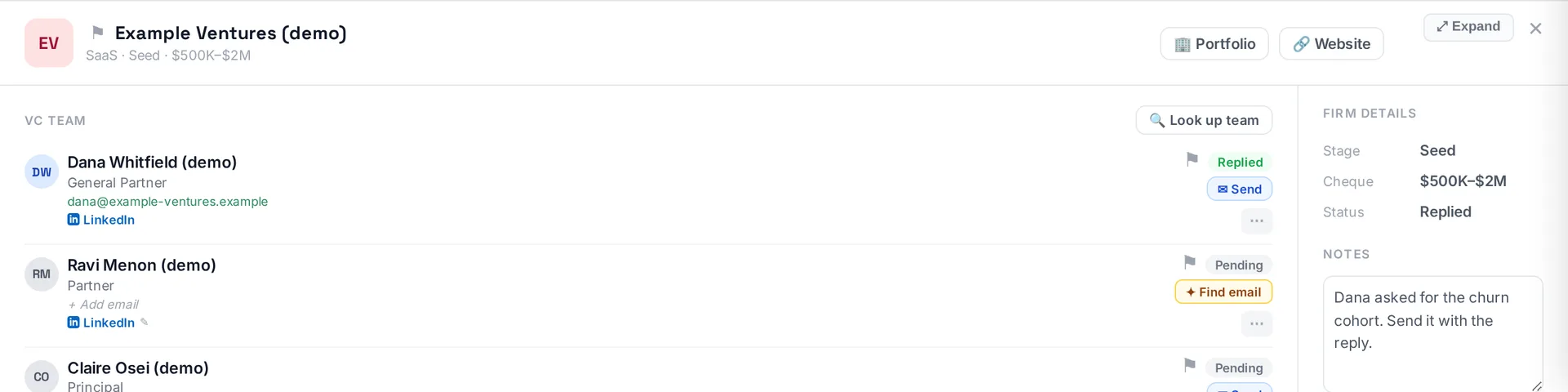
The firm panel also has “Meeting Notes” and “+ Add notes.” Enter the date and notes; review the summary and action items before saving. If you use “Generate summary,” compare it with your notes and correct omissions. Include owners and agreed dates in the action text; these instructions do not imply the tool schedules the investor’s internal review.
2. Check the deck and intended recipient in PitchLab.
Deck upload is on the dashboard. In PitchLab, confirm the active deck and version, then use “Create link” when a recipient link is needed. Review the recipient label and “Allow PDF download” setting, and test the material you intend to share.

A deck open or time per slide is recorded viewer activity, not an investment decision. A forwarded link may be used by someone else. Use the investor’s reply and meeting questions to decide the substance of the follow-up.
3. Review the message before the provider action.
FundLab distinguishes sending an email from saving a mailbox draft through a supported connected account. Review the recipient, thread, evidence links and signature. After saving, check the draft before sending it. A saved draft is not evidence that the investor received anything.

Keep important post-pitch replies under deliberate review. Do not assume an automated follow-up suggestion answers an evidence request or follows your meeting agreement. Record a phone call, in-person decision or external message manually when it is not captured in the supported thread.
Before you send: review this follow-up.
Use Tab to reach the checkboxes and Space to select them. Selections stay on this page and reset on reload. Checking an item records your own review; it does not verify the underlying evidence or send a message.
0 of 8 reviewed
Common questions
How often should I follow up after an investor pitch?
Start with the date you agreed. If there is none, ask about the review process and choose a considered check-in based on that context. This guide does not establish a universal number of days or a maximum number of messages. Deliver your own commitments and respect a pass or request to stop.
Should I send the deck again in every follow-up?
Include it when it helps answer the current question, and check which version the investor has already seen. Keep a relevant document easy to find, but avoid replacing a specific evidence request with the same pitch again. Explain a material revision.
Does a deck open mean I should email immediately?
No fixed sending rule follows from an open. It is a link activity signal, and the viewer’s identity or intent may be uncertain. Review the actual conversation, commitments and agreed date before choosing the next action.
How do I follow up after an investor says no?
Acknowledge the decision briefly if appropriate, then close the active conversation. If they explicitly name a future milestone, record it accurately. Do not add them to recurring updates without their agreement or use repeated emails to argue with the pass.
Sources and further reading
Primary sources reviewed on 3 October 2026. They support the communication principles identified above. Our stage decisions, examples and checklist are an educational framework; no source validates the fictional dates or establishes response or funding rates.
- Y Combinator: Aaron Harris on Fundraising and Meeting with Investors, 21 August 2019. Short, informative messages, concrete requests and parallel fundraising conversations. Historical market commentary is not used as a current benchmark.
- Y Combinator: Fundraising Advice for YC Companies, 23 February 2016. Keeping fundraising bounded and avoiding indefinite process. Its suggested historical timelines are not used as a universal post-pitch cadence.
- FundLab overview and PitchLab overview. Product scope; screenshots use the existing fictional and simulated demonstrations described above.