
What is a liquidation preference?
A liquidation preference gives preferred shareholders a contractual priority over common shareholders when proceeds are distributed in a covered exit or liquidation. With 1× non-participating preferred, the investor receives the better of its preference amount or the amount it would receive as common, subject to the proceeds available. With participating preferred, it takes the preference first and then shares in the remainder.
For a fictional $2M investment and 20% ownership at an $8M distributable exit, 1× non-participating pays the investor $2M and common shareholders $6M. Uncapped 1× participating pays the investor $3.2M and common shareholders $4.8M.
The same ownership and exit can therefore produce different payouts. “1×” describes the initial preference multiple; it does not answer whether participation, dividends or another class’s priority changes the result.
The comparisons below isolate those terms. They are educational examples, not an interpretation of your contract. The signed documents and applicable law govern your actual distribution; have the complete waterfall reviewed for the company’s jurisdiction.
1. Read the complete clause, not just the multiple.
Capture five items together: the event that triggers payment, the preference amount, participation, any cap and the order among preferred classes.
- Trigger: does the definition cover the proposed merger, sale or asset transaction? A “deemed liquidation event” can bring an acquisition into the clause even though the business continues.
- Amount: a 1× preference on $2M is $2M before any separately specified dividend adjustment. A 2× preference is $4M. Check the original issue price, share count and dividend wording.
- Participation: non-participating preferred chooses the preference or an as-converted payout. Participating preferred also shares the balance after preference payment.
- Cap: does the ceiling include the initial preference, and can the holder convert instead?
- Priority: is the class senior, junior or equal in priority to another class?
The NVCA’s October 2025 model charter includes alternative provisions for non-participating and participating preferred, plus definitions for covered transactions. It is a US model with drafting choices, not a rule that every company has the same terms.
A preference is a claim on the available distribution. It does not create cash when the exit proceeds are insufficient, or by itself make founders personally responsible for repaying the investment.
2. Work through one exit with one preferred class.
Fictional example: Northstar Cloud has 8,000,000 founder common shares and 2,000,000 Summit Ventures preferred shares. Summit invested $2,000,000. Conversion is 1:1, so Summit owns 20% and the founders together own 80% on an as-converted, fully diluted basis.
Assumptions for every row: USD; one preferred class; no other investors, options, unallocated pool, warrants, SAFEs or notes. All preferred shares have equal priority. No dividends, debt, transaction fees, taxes, escrow or earn-outs are included. “Exit proceeds” means the cash already available to distribute to these shareholders, not enterprise value or a headline acquisition price. Founders hold all of the common shares.
At $8M, compare the two paths.
Under 1× non-participating, Summit’s preference is $2M. Its as-converted alternative is 20% × $8M = $1.6M. It takes the $2M preference; the founders receive the remaining $6M. Do not then give Summit another 20% of the balance.
Under 1× participating, without a cap, Summit takes $2M first. The remaining $6M is shared 20/80: Summit receives another $1.2M and the founders $4.8M. Summit’s total is $3.2M. The payouts still add to $8M.
This difference follows the distinction in WilmerHale’s explanation of liquidation preferences. The numbers here are independently calculated fictional cases.
Change the proceeds; keep ownership and investment fixed.
All figures below are USD millions. “Common” is the founders’ combined payout, not any one founder’s payout. The capped column assumes a 2× total return cap, including the initial 1× preference, and a right to convert.
| Exit proceeds | Non-participating: investor | Non-participating: common | Participating: investor | Participating: common | 2× capped: investor | 2× capped: common |
|---|---|---|---|---|---|---|
| $0M | $0M | $0M | $0M | $0M | $0M | $0M |
| $1M | $1M | $0M | $1M | $0M | $1M | $0M |
| $8M | $2M | $6M | $3.2M | $4.8M | $3.2M | $4.8M |
| $10M | $2M | $8M | $3.6M | $6.4M | $3.6M | $6.4M |
| $12M | $2.4M | $9.6M | $4M | $8M | $4M | $8M |
| $20M | $4M | $16M | $5.6M | $14.4M | $4M | $16M |
| $30M | $6M | $24M | $7.6M | $22.4M | $6M | $24M |
At $1M, the entire available distribution goes to Summit and the preference is still not paid in full. At $10M, its non-participating preference and conversion alternatives are equal. Above $10M, conversion pays more for that structure.
Compare the same fictional deal at different exits.
Choose a proceeds amount to see the payout and election side by side. This public comparison runs in your browser, uses only the fixed assumptions above and requires no account.
Fictional · $2M invested · 20% as-converted ownership
At $8M available to shareholders
1× non-participating
Investor $2M
Common $6M
Takes the preference; conversion would pay $1.6M.
1× participating
Investor $3.2M
Common $4.8M
$2M preference + 20% of the $6M remainder.
1× participating, 2× total cap
Investor $3.2M
Common $4.8M
Below the $4M cap; conversion would pay $1.6M.
Showing the $8M fictional exit.
Notice the $30M case: the capped investor converts and receives $6M. A cap on participation does not necessarily impose a lifetime maximum payout on the shares.
3. Separate the initial preference from the participation cap.
Our capped case has a $2M initial preference and a $4M maximum while remaining preferred and participating. The cap includes the first $2M. Until that ceiling, Summit receives $2M + 20% of the remaining proceeds.
At $12M, that gives $2M + 20% × $10M = $4M, reaching the ceiling. Between $12M and $20M, the capped preferred payout remains $4M. At $20M, conversion also pays $4M. Above $20M, Summit does better by converting: at $30M, 20% is $6M. It receives that $6M instead of the preference and participation payments.
The cap’s inclusion of the initial preference and the separate conversion threshold are explained in DLA Piper’s liquidation preference guide. Confirm both in your own drafting; “participating with a 2× cap” is incomplete if the cap basis and conversion rights are unclear.
The simplified arithmetic
Let E = distributable proceeds, I = investment, q = as-converted ownership, P = preference multiple × I, and C = total participation cap.
- Non-participating investor: the smaller of E and the greater of P or q × E.
- Uncapped participating investor: the smaller of E or P, plus q × the positive remainder after P.
- Capped participating investor: the greater of its capped participating payout or q × E, when conversion is available. Here C = 2 × I, and includes P.
- Common payout: E minus the chosen investor payout.
These expressions apply to this single-class setup. They do not solve a stack of different priorities, conversion ratios or participation terms.
4. Rebuild the waterfall when the ownership stack changes.
A later round can introduce a new preference amount and a different priority. Equal priority, often called pari passu, means classes at that level share according to the specified entitlement when funds are short. Senior priority can pay one class before another. It does not mean every preferred holder receives the same dollar amount.
Do not apply the single-investor formula independently to each series and add the results. One class’s conversion changes who shares in the common distribution; another class’s preference changes the remainder. The resulting payouts must reconcile to the same proceeds.
Before modelling a real sale, reconcile the securities and the transaction: outstanding preferred shares, conversion ratios, dividends, option treatment, liabilities, fees and taxes, plus any amounts retained or paid later. An unallocated pool is not a shareholder who automatically receives sale proceeds. Granted options need their actual exercise or cash-out treatment.
Ask your advisers to bridge the headline price to the amount available for the waterfall, then show the amount payable now and any contingent amount separately. The NVCA model includes choices for escrow and contingent consideration; the final transaction terms decide the timing and treatment.
How to explore the preference in TermLab.
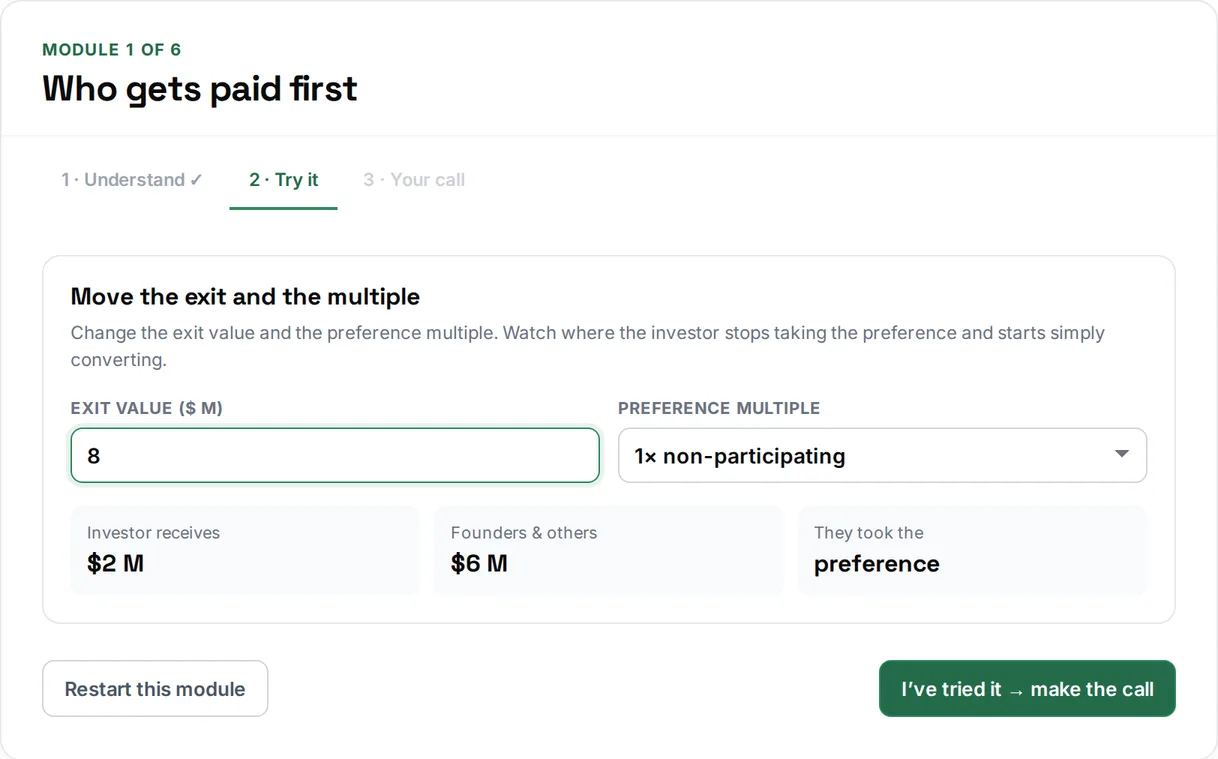
After checking the example, use TermLab to learn the clause and explore a simple scenario. The screenshot below is from the real TermLab interface using a fictional US learning example, captured by the existing read-only demo recipe. It contains no customer data.
Start with “Who gets paid first”.
Open the guided tutorial, choose the applicable jurisdiction and work through Understand → Try it → Your call. In the US lesson, the example uses $2M investment and 20% ownership. In Try it, set Exit value to 8 and Preference multiple to 1× non-participating. Review the $2M investor payout, $6M founders and others payout, and the explanation that the preference was taken.
Then compare one term at a time.
Switch the lesson to 2× non-participating at the same $8M exit. That increases the initial preference to $4M and leaves $4M for common. Then increase the exit: at $30M, converting to 20% gives $6M, exceeding either initial preference. Record the assumptions and election with each comparison.
For the full workflow, confirm the deal and investor terms before opening Simulate → Waterfall, entering the exit value and choosing Calculate Waterfall. Review the payout table and total. The current full Simulate and Negotiate stages require a signed-in account with the relevant paid or trial access; check current access and pricing.
Use this walkthrough for the single preferred investor illustrated here. The current simulator offers 1× and 2× participating or non-participating inputs; it does not provide a total participation cap or a complete negotiated seniority model. Use the guide’s capped comparison for learning, and a separately reviewed model for a real multi-series transaction.
Before you sign or rely on an exit estimate.
Collect these answers with the model. Checking a box records your review; it does not validate the contract.
0 of 8 reviewed
The text worksheet records the terms, proceeds bridge, fictional examples and questions for counsel. It is not an automated deal model.
Common questions about liquidation preferences.
Does a 1× preference guarantee investors get their money back?
No. In the $1M example, the $2M investor receives only the available $1M. A contractual priority does not remove the risk of losing capital.
Does a founder with 80% receive 80% of the sale?
Only under the appropriate distribution assumptions. At an $8M exit in our non-participating case, the founders receive $6M, or 75% of the proceeds. With uncapped participation, they receive $4.8M, or 60%. When the investor converts, the 80/20 ownership split applies to the full proceeds.
Does a 2× participation cap mean a 2× preference?
No. The initial preference can still be 1×. In our capped example, the first $2M is the preference and total preferred proceeds stop at $4M unless the investor chooses conversion. A 2× non-participating preference starts with a $4M entitlement and is a different structure.
Does this clause apply only if the company shuts down?
No. A defined sale or merger can be a deemed liquidation event. Read the trigger, exclusions and any waiver mechanism in the actual governing documents.
Should I accept a higher valuation with a stronger preference?
Compare both complete offers across plausible exit values, including dilution, the full preference stack and control terms. A higher valuation alone does not show which offer leaves you with more proceeds. The fictional table is a way to understand a trade, not a recommendation to accept a particular term.
Sources and further reading.
Sources reviewed 3 October 2026. These model clauses and legal explanations support the concepts; all Northstar figures and comparisons are our own fictional illustrations.
- NVCA model legal documents and its October 2025 Certificate of Incorporation: alternative preference drafting, shortfalls, covered events, conversion and contingent consideration.
- WilmerHale Launch: how liquidation preferences work: preference, conversion, multiples and participation.
- DLA Piper, The Venture Alley: understanding liquidation preferences: total participation caps and conversion. The 2011 article is used for mechanics, not a current market benchmark.
- TermLab overview and current access: product context. The walkthrough and scope above were checked against the current implementation.