
Prepare an evidence trail, an owner and an honest answer.
To prepare for investor due diligence, agree the scope of the review, assign one owner to each material claim and reconcile the deck, financial model, cap table and source records. Define the dates and measures behind your numbers. Track requests, approved responses and unresolved gaps in one register, review disclosures before sharing and keep a version history through closing.
Investor due diligence is the review of the business and the evidence supporting an investment decision. The investor may ask questions, examine records or request conversations with relevant people. Cooley GO’s explanation for UK companies describes a process with questions and document requests whose scope depends on the business. That process framing is useful; its jurisdiction specific examples are not requirements for every startup.
Your task is to help the reviewer distinguish an established fact, a forecast, an estimate and an unresolved issue. Being ready does not mean every answer is positive. It means you can explain what is known, support it and give a credible next action for what remains open.
This guide focuses on running that process. For the folder structure and document inventory, use the startup fundraising data room checklist. A tidy folder can still contain contradictory figures. The review below is how you find them.
1. Agree the scope and give each answer an owner.
Ask the investor for the current request list, the intended reviewers and the decision they are trying to make. Confirm the entity, financing instrument, reporting period, expected response timing and whether another reviewer is coordinating legal or financial questions. Use their actual requests to prioritize the work.
An early conversation may need a small packet of evidence behind the pitch. An active investment review may need deeper source records. Closing may need a separate set of agreed conditions and executed documents. These are planning stages, not universal gates. Industry, stage, geography and deal structure can change the scope.
Choose one person to coordinate the process and one owner for each answer. In a small team, the founder may fill both roles, with an accountant or lawyer checking the relevant matters. Ownership means gathering the evidence and keeping the response current; it does not mean personally certifying every legal or accounting conclusion.
Use specific completion conditions. “Finance done” is hard to review. “September actuals agree with the ledger, and every difference from deck v04 is explained in FIN_01” gives the owner and reviewer a shared task. Set dates that reflect the work required, and flag a missed date before it becomes a silent gap.
Cooley GO’s US sample request list includes company actions, securities records, agreements and other evidence. Use it to spot possible omissions, then have advisers adapt the list to your company. Do not mark a document legally required solely because it appears in a sample.
2. Reconcile the story before sending more files.
Start with the claims an investor is most likely to repeat in their own review: traction, cash, growth, ownership, customer relationships and product or IP ownership. Put each claim beside the evidence and compare the definitions. A difference may be an error, a timing difference or two legitimate measures being used under one label.
| Claim | Compare | Question to resolve |
|---|---|---|
| Revenue and growth | Deck, model actuals, accounting records and operating reports | Same entity, currency, period and measure? Are bookings, invoices, cash and revenue labelled separately? |
| Cash and runway | Cash position, forecast opening balance, burn assumptions and committed obligations | Same reporting date? What is available, restricted, already spent or assumed to arrive? |
| Customer traction | Deck customer count, usage records, signed agreements and billing evidence | Are these paying customers, free users, pilots or signed customers who have not started? |
| Ownership | Cap table, securities records, grants, approvals and financing agreements | Same date and denominator? Are options, reserved pool and convertible instruments treated explicitly? |
| Team and IP | Pitch claims, contributor history and relevant signed agreements | Does the record support the claimed relationship or ownership? What remains under review? |
For every number, write down the entity, date or period, currency, definition, numerator, denominator where relevant, source and review status. “20 customers” needs an inclusion rule. “80% retained” needs a starting cohort, observation period and the count still present. State whether retention refers to accounts or revenue. An unexplained percentage cannot answer the investor’s question.
Make the actual versus forecast boundary visible in the model. If a source report ends in August and the deck describes September, identify the interim source and its limitations. Do not imply that a forecasted September result has been achieved. The seed financial model guide explains how to organize actuals, assumptions and funding needs.
For ownership, keep an issued share view separate from any fully diluted or financing scenario view and explain the denominator. Read the signed instruments and include side letters in the review. A simplified SAFE scenario cannot replace the actual agreement; the SAFE caps and discounts guide gives a worked conversion framework. Reconcile employee grants with the plan and supporting records using the vesting guide as a set of review questions.
3. Turn a discrepancy into a correction and a response.
Fictional example: Cedar Loop, Inc. is preparing for a seed review. All company details, people, files and numbers below are invented. Its deck says “September revenue: $42,000.” The model contains $42,000 of September bookings, while the reviewed ledger shows $30,000 of September revenue.
| Record | Value and meaning | Review finding |
|---|---|---|
| Deck v04, slide 8 | $42,000 labelled revenue | The label is unsupported by the reviewed ledger. |
| Model v06, bookings tab | $42,000 of signed contract value entered in September | Bookings uses a different definition from recognized revenue. |
| September ledger v02 | $30,000 of revenue recorded for September | The finance reviewer reconciles this to the supporting schedules. |
| Reconciliation note FIN_01 | $12,000 difference | In this invented case, entirely explained by service scheduled for later periods. |
The subtraction is $42,000 minus $30,000, or $12,000. That arithmetic identifies the difference; it does not establish the explanation. The finance owner checks the contract dates, service schedule and accounting treatment with the reviewer. In this fictional case, those checks explain the full difference. In a real review, leave any unexplained balance open.
The founder corrects deck v04 to v05, labels September revenue as $30,000 and keeps bookings as a separate measure. The model’s actual revenue line is checked against the same ledger. If an earlier deck has already been shared, the team tells its recipients which slide changed and why. Quietly replacing the file would leave them using the original claim.
Copy the fictional response note
REQUEST: FIN_01, reconcile September revenue
ENTITY / PERIOD: Cedar Loop, Inc.; September 2026; USD

We identified a labelling error in deck v04, slide 8. The $42,000 figure represented September bookings, not September revenue. The reviewed September revenue figure is $30,000.

In this fictional example, the $12,000 difference is explained by service scheduled for later periods, as set out in reconciliation note FIN_01 v02. The reviewed sources are the September ledger v02, contract schedule v03 and model v07.

Deck v05 supersedes v04 for this claim. Bookings and revenue now have separate labels. Please use the corrected deck and note for your review.

OWNER: Priya, finance lead (fictional)
REVIEWER: Arun, founder (fictional)
STATUS: Internal reconciliation reviewed; awaiting investor follow-up
OPEN ITEMS: None identified in this fictional reconciliation
RESPONSE DATE: 3 October 2026
Invented example. Replace the details, verify the explanation and approve the recipient before sharing.
For an unresolved matter, say what was found, which conclusion cannot yet be supported, who is investigating and when you will update the reviewer. For example: “A contractor assignment record has not been located. We are reviewing the ownership position with counsel and will update IP_02 by the agreed date.” A missing record is not automatically a proven ownership defect, and it is not a verified clean position.
4. Use one register for requests, issues and released answers.
Give each investor question a stable reference. Keep the original question, source location and latest response together. Record the owner, reviewer, target date, definition, source versions, disclosure decision, release date and what would close the item. If several investors ask the same question, maintain the reviewed answer centrally while tracking each recipient’s release separately.
The blank Excel worksheet has headings and an empty row. The fictional version includes the revenue discrepancy, an IP record gap and a reference request. Fill it in your own approved workspace. These files are organizational aids and contain no real company, investor or customer information.
- Open: the question is understood and has an owner.
- Reviewing: evidence or the explanation is being checked.
- Responded: an approved answer has been released to the named reviewer.
- Follow-up: the reviewer needs more evidence or clarification.
- Closed for this request: the agreed completion condition has been met.
- Not applicable: the reason is recorded and reviewed for this company.
“Responded” is not the same as “resolved.” An investor may have received the ledger but still need the reconciliation. An internal owner may finish a task while the deal team still needs to agree how to handle an exception. Keep those states distinct.
Review the open items together at an agreed cadence. Focus on new questions, changes to an earlier answer, approaching dates and decisions requiring an adviser. If an investor changes the scope, preserve the original request and add the follow-up. This avoids losing the question in a stream of new attachments.
6. Keep closing versions and exceptions under control.
When the process moves toward signing, separate the current transaction documents from older fundraising materials. Work with the deal team and counsel to maintain a list of agreed conditions, responsible people, required evidence and remaining decisions. Mark draft, approved and executed versions clearly.
NVCA’s US model financing documents show how a financing can involve several related agreements. NVCA states that its models need tailoring to the specific circumstances. Use counsel to identify the appropriate documents, approvals and filings for your entity and deal; a US model set does not determine the closing requirements in India or Singapore.
Keep a change log with the request reference, prior version, replacement, material change, approval and recipients informed. Recheck the deck, model and cap table when the agreed financing terms change. A cap table prepared for an earlier round size should not quietly accompany a different final agreement.
Give each unresolved exception a description, implication under review, owner and decision date. The appropriate parties decide whether it needs remediation before closing, different agreed treatment or further investigation. Do not classify a matter as waived without documented agreement, or mark a closing condition complete because someone has uploaded an unsigned draft.
After signing, preserve the executed set and the final ownership and funding records. Assign owners to any agreed later actions and review ongoing access. An “all done” folder is less useful than a clear handover of what was completed and what still needs attention.
How DDLab helps you prepare the supporting records.
Use DDLab alongside the request register. DDLab organizes preparation statuses and notes across seven folders. It has India, United States and Singapore checklists with Pre-seed and Seed views. It does not reconcile your numbers, upload your source files or host the investor’s review workspace.
1. Select the relevant company context.
Open the checklist and check the region and stage. Compare its suggested items with the actual investor list and adviser guidance. The region choice can affect the context in other tools, so confirm it before switching.

2. Record status and useful notes.
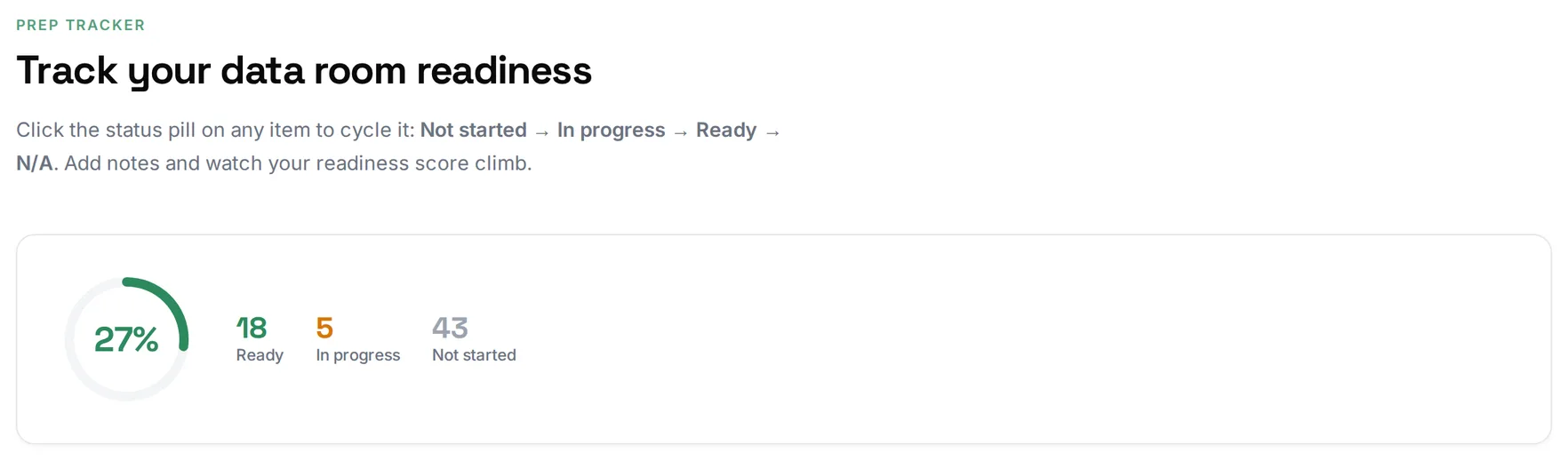
Use Not started, In progress, Ready or N/A for the preparation items. Put the request reference and next action in the note so you can connect it to your separate register. A Ready status is your preparation judgment; the percentage does not independently verify the evidence or establish legal compliance.
A free account is required to change the checklist. For signed-in free users, preparation progress is kept in that browser. Paid or eligible trial access enables account saving and the ZIP download. Check the current access options for your account before relying on those features.
3. Use the ZIP as a structure to populate and review.
The ZIP includes seven folders with a guidance README in each and 00 - Master Checklist.txt at the root. It does not contain uploaded evidence, a verified diligence report or a reconciliation of this guide’s issue register. Its generic guidance needs review for your company and transaction. Manage investor access and disclosure decisions in the service where you place the documents.
Screenshot provenance: existing scripted DDLab captures of fictional Northstar Cloud, Inc., a Delaware company at Seed. The product’s actual controls were exercised with simulated authentication and intercepted account data. These public image copies show the interface; they do not establish a live account save or investor access result.
Before the next response, check the evidence and the release.
This checklist is public and needs no account. Only its ticked states are saved in this browser, when storage is available. It does not save company inputs or update DDLab.
0 of 8 reviewed
Completing this checklist is a preparation aid. The investment decision, professional review and any closing conditions remain separate.
Common questions
Do I need to fix every issue before speaking to investors?
You need to understand your material claims and avoid presenting unknowns as verified facts. Some issues can be investigated during the process. Record the gap, owner, next action and implications under review. Agree the handling of material exceptions with the relevant deal parties and advisers.
What if the investor asks for a document we do not have?
Distinguish a record that does not exist, a record that cannot be located and a category that is not applicable. Explain the actual situation and ask what question the investor needs answered. An alternative source may help, but do not represent it as the requested document.
Should the deck and model always have identical numbers?
Comparable actual measures should agree for the same period, entity and definition. A rounded deck figure can differ from a detailed model if the rounding is clear. Bookings, revenue, cash receipts and forecasts may legitimately differ; they need distinct labels and an explanation.
Does a 100% readiness score mean diligence is complete?
No. A checklist score summarizes the statuses entered into that checklist. It does not verify source records, clear unresolved exceptions, approve disclosure or show that an investor’s questions and closing conditions are complete.
How long should investor due diligence take?
There is no fixed timeline in this framework. Scope, company stage, available evidence, reviewer availability and unresolved questions can affect it. Agree a response cadence and target dates with the actual reviewer rather than promising a standard number of days.
Sources and related guides
The workflow, register and fictional example are our educational framework. Primary sources reviewed on 3 October 2026:
- Cooley GO: sample VC due diligence request list, with a US sample PDF. Illustrates the breadth of requests and source records.
- Cooley GO: the due diligence process for UK companies. General process explanation, last reviewed by its publisher in September 2015; not used here as current legal requirements.
- NVCA: model legal documents. US financing examples and explicit guidance to tailor them to the specific circumstances.
The appropriate legal documents and disclosure obligations depend on your jurisdiction, company and transaction. Have counsel review those matters, and use an accountant for accounting judgments and reconciliations that need professional review.

Builder of The Founders' Stack, tools for fundraising and company preparation. About Ashish.