
Employee vesting determines when an equity award is earned. A cliff delays the first vesting event; the schedule defines subsequent tranches. For an option award, vesting does not itself issue shares. On departure, separate what has vested from what remains unvested, then check the actual grant's lapse, exercise and leaver terms.
This guide explains general concepts for founders and employees. Its dated option example is fictional and independent of any country's rules. Your approved plan, grant agreement and local requirements govern the real award. Use the worksheet to identify questions for the person responsible for administering it.
Carta separates option vesting from the right to purchase shares. Source: Carta, vesting guide.
1. Keep the grant, vesting and exercise separate
| Term | What to track |
|---|---|
| Grant | The awarded option count, exercise price, approval and agreement. |
| Vesting | How much of that award has been earned under its conditions. |
| Exercise | Using the option to purchase shares, subject to the exercise conditions. |
| Issued shares | The shares actually acquired, with their own rights and restrictions. |
| Liquidity | Whether an allowed sale or another cash realization is available. |
Vested options can remain unexercised. Exercising requires a separate process and payment of the exercise price; owning private shares does not establish a ready buyer. Source: Carta, exercising stock options.
Check the award type first. An award of shares subject to vesting needs different records from an option to buy shares. Do not apply the option exercise steps in this guide to every form of employee equity.
Also distinguish grant date from vesting commencement date. Ask which date the agreement uses to start the schedule. The fictional example sets both to 1 January 2025, deliberately. A later grant or refresh award should have its own reviewed schedule.
2. Specify the schedule in a complete sentence
“Four years with a one-year cliff” is a useful label. A complete review also needs the start date, first tranche, later frequency, rounding and conditions for continued service.
Fictional grant wording for calculation only: 4,800 options. Vesting commences on 1 January 2025. No options vest before 1 January 2026. On that date, 1,200 options vest; another 100 vest on the first day of each month from 1 February 2026 through 1 January 2029, provided the assumed service condition continues.
This is a worked schedule, not contract language to copy into a live grant. Carta describes this structure as a four-year schedule with a one-year cliff and monthly vesting after it. Source: Carta, cliff vesting.
Make the conditions measurable
For monthly, quarterly or annual vesting, write down the actual tranche dates. For a milestone condition, specify what counts as completion and who confirms it. For a combined schedule, ask whether both time and the milestone must be satisfied. SeedLegals' scheme guide illustrates time-based and milestone choices, and separately defined exercise rules in its UK scheme documents. Source: SeedLegals, option scheme rules.
For acceleration, ask what event triggers it, how much accelerates and what additional conditions apply. Do not infer acceleration from an acquisition announcement or from the word “vested” in a dashboard.
3. Follow the dates and denominator
Fictional example: Alex receives 4,800 options with the schedule above. All percentages below use 4,800 awarded options as the denominator. They are percentages of the grant, not ownership percentages of the company.
- Schedule starts: 0 vestedThe grant date and commencement date are the same in this example.
- Before the cliff: 0 vestedNo daily vesting is assumed. Remaining unvested: 4,800.
- First vesting: 1,200 options, 25%The first 12 months vest together at the cliff.
- Next tranche: cumulative 1,300100 additional options. 27.08% of the grant, rounded.
- As of date: 2,100 vested, 43.75%Nine monthly tranches after the cliff, through 1 October. Unvested: 2,700.
- Fully vested: 4,800 options, 100%36 monthly tranches after the cliff complete the grant.
Check the arithmetic independently
Cliff tranche = 4,800 × 12 ÷ 48 = 1,200. Remaining options = 4,800 − 1,200 = 3,600. Monthly tranche = 3,600 ÷ 36 = 100.
As of 3 October 2026: 1,200 + (9 × 100) = 2,100. The remaining 2,700 have not vested. The 100-option monthly tranche is 1/48 of the grant, or approximately 2.0833%. Multiplying a rounded 2.08% by every month would lose precision.
Nothing in this calculation values the options, calculates tax, establishes company ownership or forecasts a payout.
Try a dated timeline
Change the option count and dates for the same fixed 48-month schedule, 12-month cliff and monthly anniversary vesting. This public calculator runs in your browser. Inputs are not saved or sent to an account.
As of 2026-10-03: 21 completed anniversary months, 2,100 vested options out of 4,800. First vesting: 2026-01-01. Fully vested: 2029-01-01. Last vesting date: 2026-10-01.
Example limits: start day must be the 1st through 28th, avoiding month-end conventions. Calendar dates have no time-of-day rule. Vesting occurs on anniversaries, not daily. Before the cliff the result is zero; at 48 months it reaches the full count. For indivisible grants, cumulative vested options are rounded down after calculating awarded options × completed months ÷ 48. Percentages display two decimals. This rounding convention may differ from your plan.
The calculator assumes uninterrupted service, no acceleration, amendments, early exercise or forfeiture. To examine a departure, set “As of date” to the agreed vesting stop date, then review the separate leaver terms. With JavaScript unavailable, the worked example above remains readable.
4. Review departure as a separate event
A leaving date alone is not a complete equity instruction. Assemble the approved terms, the applicable service stop date and any amendments. Review unvested options, vested unexercised options and already issued shares separately.
| Vesting stop date | Vested / unvested | Question still to resolve |
|---|---|---|
| 31 Dec 2025 | 0 / 4,800 | Does the agreement cancel the unvested award, or provide an exception? |
| 1 Jan 2026 | 1,200 / 3,600 | Does the first tranche count on this service stop date? |
| 17 Sep 2026 | 2,000 / 2,800 | What happens to the vested options, and when may they be exercised? |
At 17 September, Alex has completed 20 anniversary months. The 1 September tranche brings vesting to 1,200 + (8 × 100) = 2,000. This example does not add a partial September tranche.
In Carta's US-oriented explanation, unvested options generally lapse on departure, and vested options have a post-termination exercise period. Read the actual agreement for the deadline; a quoted 90-day window is not a universal entitlement. Source: Carta, leaving a company.
Read the definitions behind “good” and “bad” leaver
These labels do not have one universal outcome. SeedLegals describes optional leaver categories and exercise conditions in its own UK option schemes. That illustrates document choices, not a rule for all international grants. Source: SeedLegals, exercise and leaver rules.
Ask who makes the classification, what facts trigger it, whether discretion applies, and how it changes vested and unvested awards. Do not classify a resignation, dismissal, redundancy or illness from its everyday label alone. Where shares have already been issued, review their transfer or repurchase provisions separately.
Write down any exercise conditions and deadline, who sends the notice, the required payment and the responsible administrator. Confirm the process before returning an award to available pool capacity. A vested unexercised option and a cancelled option are different records.
Use ESOPLab to review the records
ESOPLab has Learn and Track modes. The educational Learn mode can be opened without signing in. Track requires sign-in and saves plan and grant data to your account. Its current interface includes pool setup, Add Grant, a grant detail timeline and leaver controls.
- In Learn, work through the vesting concepts and compare them with your proposed terms.
- In Track, review the plan's fully diluted shares, reserve, currency and granted capacity before entering an award.
- In Add Grant, check employee details, option count, strike price, Grant date, Cliff (months) and Total vest (months) against the reviewed documents.
- Open the saved grant's detail view to inspect its schedule and vested count. Keep the actual commencement date and agreement alongside it.
- Before recording a leaver, confirm the applicable terms and service stop date with the administrator. Compare the proposed change with the reviewed award record.
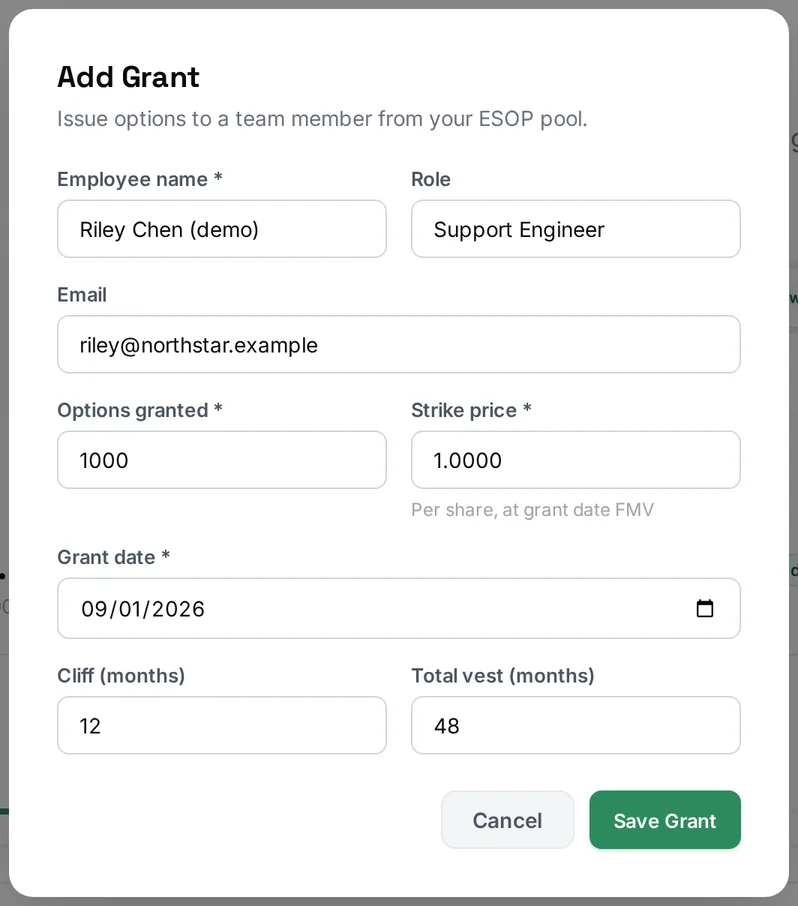
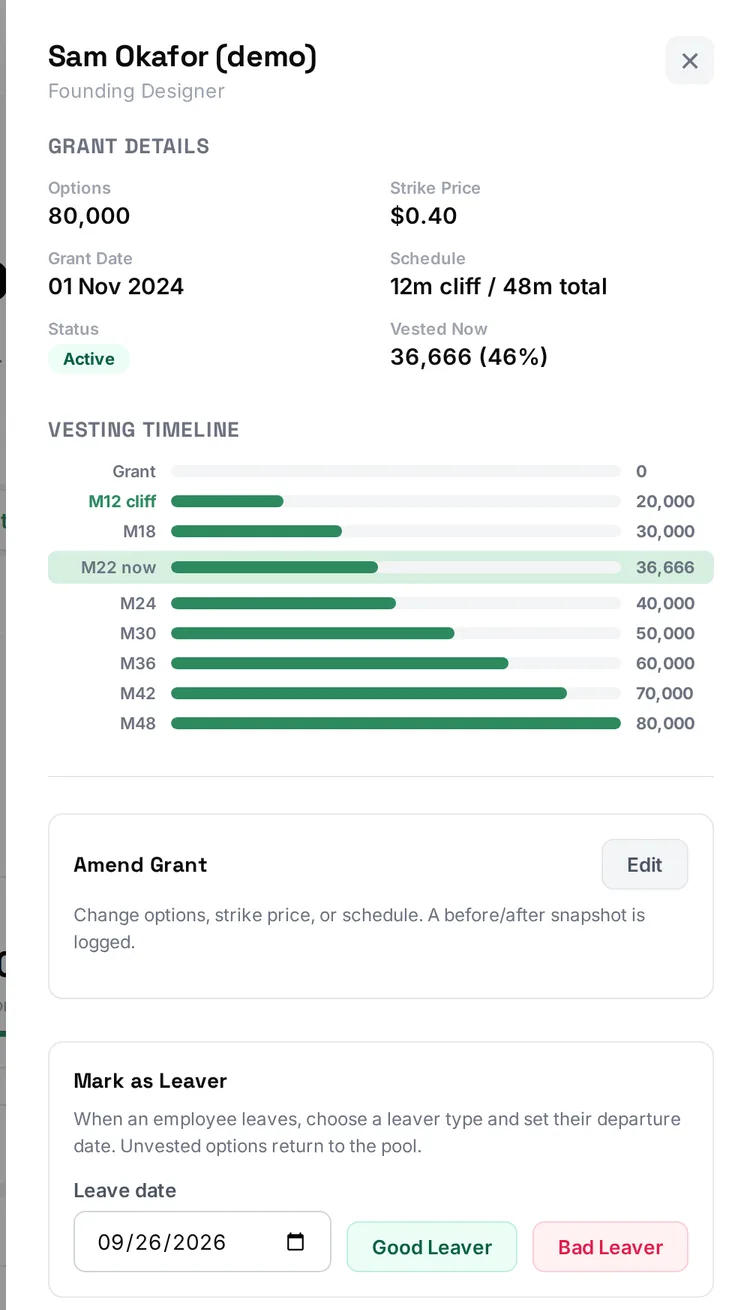
Check the product's assumptions against the agreement. Track currently uses Grant date as the schedule start and counts elapsed calendar months. Check the exact commencement date and anniversary before relying on the displayed result, especially for mid-month dates.
The current Good Leaver scenario freezes vesting at the leave date; Bad Leaver sets vested options to zero. These are fixed software scenarios. They do not determine the legal classification or exercise deadline for your grant. Keep exercise, lapse and already issued shares reconciled separately.
Screenshot provenance: the existing ESOPLab capture recipe rendered invented employees and an in-browser simulated plan on 26 September 2026. These public copies contain no customer data. They demonstrate interface states, not saved live grants or approved legal terms. The public calculator above is independent of the tracker.
The ESOPLab preview illustrates a smaller grant-vesting task. Results require an account; signed-in runs send the inputs to the platform. Use the calculator on this page for the local dated example.
Questions to take to the grant administrator
A useful review ends with exact answers, named documents and an owner for unresolved questions. Use this worksheet before discussing the award with the recipient.
- What is the award type and option or share count? Which approvals and agreement version apply?
- Are grant date, employment start and vesting commencement different? How is prior service credited?
- What vests at the cliff, on which date, and on which later dates? What are the rounding and month-end conventions?
- How do leave, a role change, part-time service or an amendment affect vesting?
- What triggers acceleration, and is another event or continued service required?
- Which service stop date applies? Who decides any leaver classification, and what does it change?
- When may vested options be exercised, what expires first, and what notices and payment are required?
- What must be recorded for exercised awards, cancellations and available reserve? Who reconciles the cap table?
Download the review worksheet ↓
The worksheet contains questions and the fictional arithmetic. It does not prescribe a grant, exercise decision, compensation benchmark or local tax treatment.
Before promising or recording a grant
0 of 7 reviewed
Checklist progress stays on this page and resets when it is reloaded.
Common questions
Does a one-year cliff mean vesting starts a year later?
In the fictional example, the clock starts on 1 January 2025, but nothing vests until 1 January 2026. The first tranche catches up 12 of the 48 months. The total duration still ends on 1 January 2029. Read your award's actual first-tranche definition.
Does 25% vested mean 25% of the company?
No. For Alex it means 1,200 of the 4,800 awarded options. Company ownership needs the relevant company share denominator, award treatment and measurement date. Vesting does not calculate that percentage.
Can I exercise every vested option immediately?
Check the exercise conditions. Some awards restrict when exercise is permitted. The calculator reports vesting only; it does not determine exercisability, the payment due or the expiry date.
Do vested options always survive departure?
Do not assume that. Review the approved award's lapse and leaver terms, any exercise deadline and applicable requirements. The fictional departure table reports the schedule amount before applying those separate terms.
Can I use the calculator for a quarterly or milestone grant?
No. It models only the stated 48-month, 12-month cliff, monthly anniversary example. Use the worksheet to document other schedules and have their calculation checked separately.
Sources and further reading
Primary source pages checked on 3 October 2026. This guide uses their conceptual explanations without adopting their market statistics, recommended terms or tax guidance. All Alex calculations and worksheet prompts are our independent educational examples.
- Carta: Vesting, schedules and cliffs, for option vesting and the four-year cliff structure.
- Carta: Exercising stock options, for the separate purchase process and private-share liquidity.
- Carta: Equity when leaving a company, for departure and exercise-window terminology in its US-oriented context.
- SeedLegals: Option scheme rules, for schedule, exercise and leaver choices in its own UK scheme documents.
ESOPLab instructions and limitations were checked against the current interface and calculation on 3 October 2026. No live account was changed.