
Make the company, fit and next step clear.
An investor introduction email should explain what your company does, give one or two relevant facts, state why you are approaching this recipient, make your fundraising intent clear, and ask for one easy next step. For a warm introduction, first ask the mutual contact whether they are comfortable connecting you, then provide a short blurb they can forward. For a cold introduction, write directly using the investor’s preferred contact route.
The purpose of the first message is to help someone decide whether to continue. You do not need to fit your entire pitch into the email. You do need enough context that the reader can tell what you are building, why you contacted them and what you want.
This guide offers our practical framework, three copyable templates and a fictional example. The templates and checklist work without an account. A reply, an introduction or a meeting is a step in a conversation, not a commitment to invest.
1. Choose the route before writing the email.
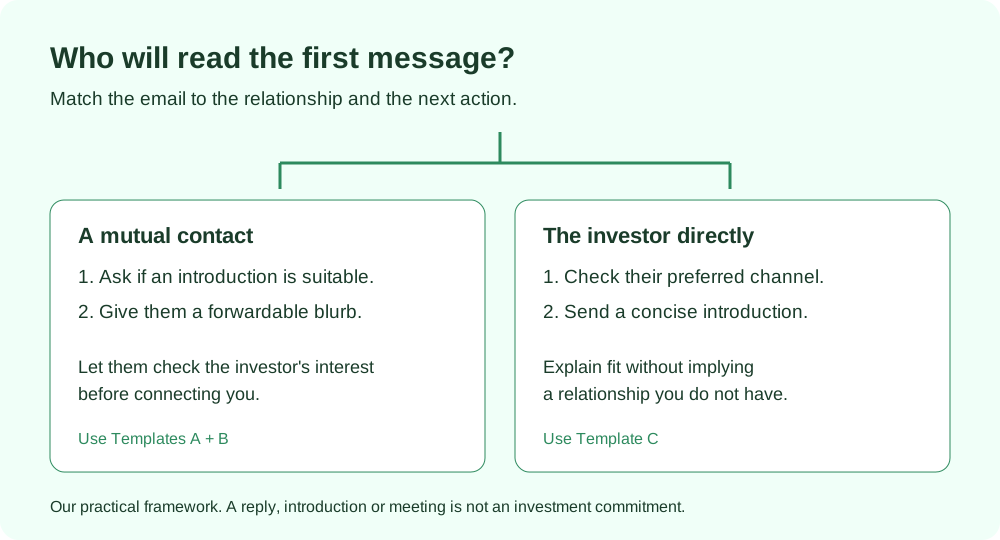
“Investor introduction email” can mean three different messages. Sending a connector the same cold pitch you would send an investor makes them work out what to do with it. Give each reader the context and action they need.
| Message | Reader | Next action |
|---|---|---|
| Warm introduction request | A person who knows you and may know the investor. | Decide whether an introduction is appropriate and whether they are comfortable helping. |
| Forwardable blurb | The connector first, then the investor. | Forward a complete, relevant summary to check interest. |
| Direct cold introduction | An investor you have not met. | Assess fit and choose whether to reply or request more information. |
Our suggested warm route is to ask permission, provide the blurb, and let the connector check the investor’s interest before adding both of you to a thread. Do not imply an endorsement the connector has not given. If the relationship is weak or they decline, respect that and consider the investor’s published submission route.
Techstars’ investor pipeline guide distinguishes an initial message to allies from the forwardable email they can pass on. Its useful test is whether the forwarder can use the message with very little work. A warm route is an option when the relationship makes sense; it is not a requirement to contact every investor.
2. Check the recipient before claiming a fit.
Start with your investor shortlist. Check the firm’s own website, the person’s current team page, relevant investment announcements and any stated submission instructions. Record the source and date beside your fit note.
Look for a reason specific enough to survive replacing the investor’s name. “You invest in early stage companies” says little. “Your published focus includes seed software for finance teams, and we build close management software for that customer” makes the proposed connection visible.
A public investment is evidence of a past investment. It does not establish that this partner led it, that the firm wants another similar company, that it has current capital available, or that it will invest in your geography. Keep those questions open unless you have checked them.
For a portfolio reference, verify the company and relationship. Consider whether it is a direct competitor before sending sensitive details. For a mutual contact, check how they know the investor rather than treating a social connection as a recommendation.
Write your reason in a private research note first: claim → source → date checked → remaining question. The email needs the useful sentence, not the whole research log. If you cannot support the sentence, remove it rather than adding generic praise.
3. Build a short message from five facts.
Before polishing, write down the customer, problem, solution, strongest current evidence and purpose of this contact. Then connect them to the recipient. Michael Seibel’s YC guidance recommends a concise explanation of the company, a reason to pay attention and an explicit request. He also cautions against spending excessive time obtaining a warm introduction. Adapt the request to what this reader can reasonably do.
- What you do. Name the customer and useful outcome in ordinary language. Replace “AI powered end to end financial transformation” with the task the customer completes.
- Evidence. Choose a fact that matters at your stage. Label paying customers, unpaid pilots and interview findings separately. Add a date or reporting period to a metric.
- Why this person. Use the verified fit sentence. Avoid claiming you follow their work if you have only seen a list entry.
- Why now. State whether you are opening a round, exploring a later raise or seeking a specific piece of advice. If you are raising, give the round amount and purpose. Do not disguise an investment request as a request for mentorship.
- The next step. Ask the connector about an introduction, or ask the investor whether the company is within their focus and whether they would like a short deck. If a meeting is already appropriate, offer a clear duration and scheduling options.
Give the subject line useful context.
Use the company name and the purpose: “Northstar Cloud | seed introduction” or “Introduction request: Northstar Cloud to Dana Whitfield”. These are fictional examples. Avoid “Re:” on a new conversation, invented referrals, exaggerated urgency and vague subjects such as “Amazing opportunity”.
Keep the core email readable on a phone. Remove the long origin story, unexplained acronyms and multiple requests. If you include a deck, use the recipient’s preferred format and test access. Share the version you are comfortable having forwarded. The Techstars guide also warns that emailed decks can travel beyond their first recipient.
4. Adapt the right template.
Replace every bracket with a checked fact and remove optional lines that do not help. These are our editable templates, not messages from a real founder or investor. You can copy each one or download the set. Your selections and copy actions stay on this page.
Subject: Introduction request: [Company] to [Investor name]

Hi [Contact name],

[Brief reminder of how you know each other, if needed.]

We build [solution] for [customer]. [One current, relevant fact, with a date or period.] We are [raising amount and stage / preparing a later round].

I am considering [Investor name] at [Firm] because [specific fit supported by a source you checked]. Do you know them well enough to assess whether an introduction makes sense?

If you are comfortable, I can send a short blurb for you to forward and check their interest. No problem if this is not a suitable connection.

Thank you,
[Founder name]
[Company website]
Send this to the mutual contact. Do not add the investor to the thread before the connector agrees.
Subject: [Company] | introduction to [Investor name]

Hi [Contact name],

Thank you for considering an introduction to [Investor name] at [Firm]. Please feel free to forward the note below to check their interest.

--- Forwardable note ---
I am [Founder name], founder of [Company]. We help [customer] [complete a specific task] through [plain description of the product].

[One or two relevant facts, including their period and status.] We are raising [amount and round] to [next milestone].

[Investor name]'s [verified focus or relevant investment] prompted this request. Would [Investor name] be open to reviewing a short deck to assess fit?

[Optional: reviewed deck link or a short, shareable overview]
[Founder name] | [Company website] | [Founder email]
--- End note ---
The note below the divider stands on its own. Keep private background, the connector’s opinions and sensitive attachments outside it. The connector can add their own context in their own words.
Subject: [Company] | [stage] introduction

Hi [Investor name],

I am [Founder name], founder of [Company]. We help [customer] [complete a specific task] through [plain product description].

[One relevant fact with its period and status.] We are raising [amount and round] to [next milestone].

I am reaching out because [specific reason connected to your company and verified against the investor's current public information].

Is this within your current investment focus? If so, may I send a short deck?

Thank you,
[Founder name]
[Company website]
Word document. Copying or downloading does not send an email or save a draft to a mailbox.
5. Review a complete example for claims, not just tone.
Fictional example: Maya Rao, Northstar Cloud, Dana Whitfield and Example Ventures are invented. All figures, the stated investor focus and plans below are illustrative.
Before
“Hi Dana, we are a revolutionary AI platform transforming finance. I know you love companies like ours. We have amazing traction and are closing soon. Can you invest and introduce us to your partners?”
What needs fixing
The product is unclear. The investor preference is asserted without evidence. “Amazing traction” has no definition. The urgency may be invented, and the reader has two substantial requests to interpret.
Subject: Northstar Cloud | seed introduction

Hi Dana,

I am Maya, founder of Northstar Cloud. We make close management software for mid-market finance teams.

At 30 September 2026, we had 120 paying customer companies and $120,000 in monthly recurring revenue. We are raising a $2 million seed round to expand the product and reach 200 paying customers.

Example Ventures' published focus on seed software for finance teams prompted me to reach out.

Is this within your current investment focus? If so, may I send a short deck?

Thank you,
Maya Rao
northstar.example
The rewrite makes the task and metrics visible. The “published focus” sentence assumes the fictional founder has checked it; you must do that check for a real recipient. The customer target is a plan, not a promise. The invented September metrics here illustrate the email; they are not evidence of company progress.
Before sending your version, reconcile any metric with the deck and your own records. For recurring revenue, confirm the definition rather than substituting bookings, cash collected or a one-time project fee. If you have no revenue, describe the actual product, pilot or research milestone instead.
How to use FundLab to prepare and review an introduction.
Once you have the facts, FundLab gives you a place to keep the investor record, contact, reusable template and draft. The full tool requires a signed-in account with eligible access. Lookup and drafting credits depend on the account; sending and saving mailbox drafts require a supported connected mailbox and are subject to its limits.
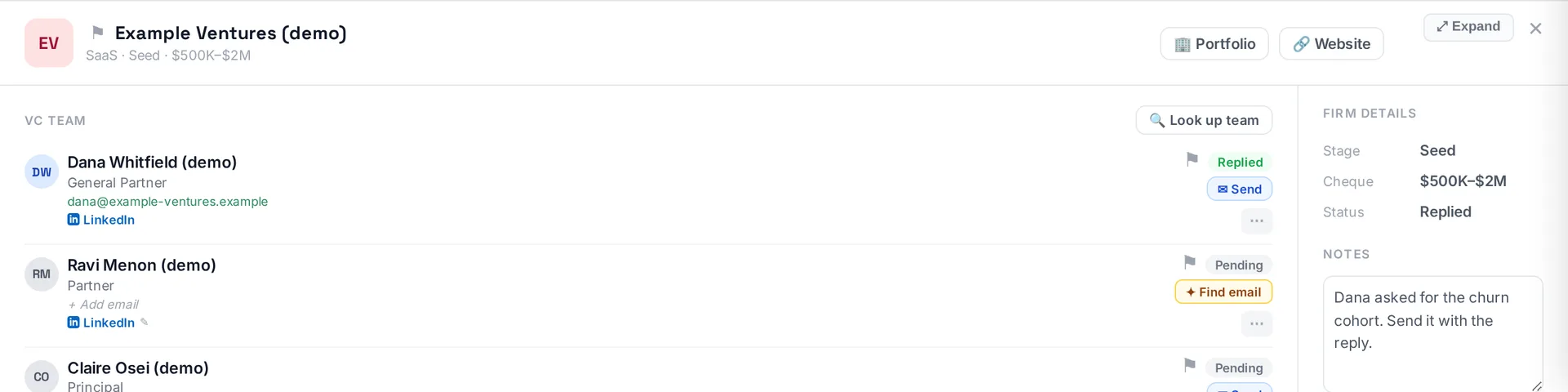
Screenshot provenance: these are existing captures of FundLab’s real interface with fictional Northstar Cloud data, invented demo firms and contacts, a simulated Gmail mailbox and stubbed provider responses. No real investor was contacted. The captures show a workflow, not live verification of an account, investor address or provider connection.
1. Review the firm, person and current conversation.
Open the firm’s card and review the team, firm details and notes. Check the person’s role and preferred contact route against their current public information. A contact lookup or a portfolio match is a starting point for research, not confirmation of investment appetite.
2. Prepare a reusable base, then personalize the message.
Open Template, then Template & Profile → Templates → Email → VC outreach. Enter the subject and body and use Save changes. FundLab supports replacement tokens such as [PARTNER_NAME], [VC_FIRM] and [FOUNDER_NAME]. The bracketed instructions in the article’s templates are for you to replace manually; they are not all FundLab tokens.
Use the direct introduction as a base for investor outreach. A warm request goes to your mutual contact; the forwardable note goes to that contact for them to pass on. Keep those recipients and purposes distinct. Do not label a cold contact as a referral.
When opening the contact’s email composer, review the actual recipient, resolved text, subject and links. A portfolio token can insert company names, but you still need to check whether those names support the reason you give. If you use [PITCH_DECK_LINK], FundLab attempts to create a tracked link from your active PitchLab deck; check the link and any error before using it.
3. Save a draft when you still need to check something.
The composer has separate Send Email and Save as Draft actions. Save as Draft stores a draft through the connected mailbox and keeps a record in FundLab so you can reopen it from the firm. Recheck the content when reopening it. The existence of a draft does not mean an investor received anything.

4. Record the next action from what happened.
After sending through your own mailbox, keep the record aligned with the conversation. A bounced address needs correction. A reply needs a response. A deck view alone does not establish interest. If the mutual contact is still checking whether an introduction is suitable, record that as the pending action rather than a meeting secured.

Use the copy controls above to prepare the educational templates without an account. This article does not connect a mailbox, find an address, save an account draft or trigger outreach.
After an introduction, close the loop.
When the connector has introduced you, thank them and respond to the investor with the context needed to continue. Follow the thread’s request rather than pasting your whole cold email again. If you move the connector out of subsequent scheduling, make that explicit and respect their preference.
If the investor asks for a deck, send the reviewed version and answer the specific question. If they offer a meeting, confirm its purpose, time and time zone. If they pass, record the reason when supplied and stop chasing that decision.
For silence, choose a review date and a reason for any further message; do not send repeated reminders simply because a tool suggests them. Ask the connector whether they have heard back before repeatedly contacting both parties. An introduction request is not permission to add someone to a recurring investor update list.
Before you send: personalize and verify.
Review the final message in your email editor. The checklist records your own review; it does not verify a contact or a claim. Selections reset when the page reloads.
0 of 8 reviewed
Common questions
How long should an investor introduction email be?
Use enough text to explain the company, the relevant evidence, why this recipient and the request. As an editing target for these templates, keep the core message to a few short paragraphs that someone can scan on a phone. That is our practical starting point, not a measured optimum or a guarantee of a response.
Do I need a warm introduction?
No. A suitable mutual contact can add context, but not every founder has one for every investor. Check the investor’s published submission preferences and use a concise direct email or application where appropriate. Do not imply a relationship you do not have.
Should I attach my deck?
Follow the recipient’s instructions. You can offer a short deck first, as Template C does, or include a reviewed deck when it helps and is welcomed. Test access and assume the material may be forwarded. Keep sensitive diligence materials for a later, appropriate sharing decision.
What can I say if we have no revenue?
State the actual stage and give a relevant fact: a working prototype, paying or unpaid pilot status, usage with a clear period, or a specific learning milestone. Do not relabel interest as customers or a nonbinding expression of interest as contracted revenue.
Does FundLab send the templates from this article?
No. The controls here copy or download text. In the full FundLab tool, you can save and adapt an outreach template, review the composed message and choose a mailbox action. Those are separate actions with account access, mailbox connection and usage requirements.
Sources and further reading
The templates, worked example, route diagram and checklist are our educational framework. Primary sources were reviewed on 3 October 2026. They support communication principles, not investor response rates or claims about the fictional recipients.
- Y Combinator: How to Email Early Stage Investors, Michael Seibel, 5 July 2016. Concise company explanation, relevant evidence, an explicit request and direct email as an available route. Individual investors’ submission preferences still need checking.
- Techstars Entrepreneur’s Toolkit: Building Your Investor Pipeline. Distinguishes contacting allies from supplying forwardable emails and explains why shared decks need care.
- FundLab overview. Full product scope. This walkthrough was checked against the current FundLab implementation; the screenshots use the fictional, simulated capture described above.