The short answer
How did Canva raise its money? Slowly at first, then very fast. Melanie Perkins pitched for years and heard no from more than 100 investors. The first round in 2013 was $1.6 million from investors plus a $1.4 million government grant. Two more small rounds came before the Series A. Canva then raised small amounts at rising prices, often when it did not need the money, all the way to $200 million at $40 billion in September 2021. It has not raised new money since.
We all know Canva from its headlines. This page is about what came before them, and what came after. I go through the founders and their first meetings, the five decks slide by slide, every round with who invested and at what price, the cap table, and what has happened to the price since 2021. The full report is a 34-page PDF; this page has the key parts, with charts you can click through.
Before the money: a yearbook business and a lot of no's
Before Canva there was Fusion Books. While studying at university in Perth, Melanie Perkins taught other students design software and saw how much they struggled. In 2007 she started Fusion Books with Cliff Obrecht, an online tool for school yearbooks, run from her mother's living room. It grew into Australia's largest yearbook company. By 2013 more than 10% of Australian high schools used it.
The bigger idea was always Canva, a design tool for everyone. To build it she needed money and a technical team, and Perth had neither. She met Bill Tai, a Silicon Valley investor and an early backer of Zoom, at a startup event in Perth, and later pitched him in San Francisco. He would invest only if she found a tech team. His message to Lars Rasmussen, co-founder of Google Maps, was simple:
“If you sign off on the tech team, I'll invest in it.”Bill Tai to Lars Rasmussen, via Forbes Australia
Lars introduced Cameron Adams, who had worked with him on Google Wave. After about two hours together and two Skype calls, Cameron joined as the third co-founder in June 2012. Meanwhile Melanie kept pitching. She spent months in San Francisco, slept on her brother's floor and worked from a mall food court for the free Wi-Fi. More than 100 investors said no. One said he was not comfortable doing a deal in Australia. In her words, it took a full year of meetings and
“one hundred revisions to our pitch deck”Melanie Perkins, Dynamic Business
The five decks
Melanie published five of her old decks, with notes on what went wrong in each. Click through them below. The dots show which of eight things investors look for each deck had.
Melanie Perkins' five pitch decks, 2008 to 2013
Pick a deck, then use the arrows to move through its slides. Each slide links to the full published deck.
The questions investors kept asking
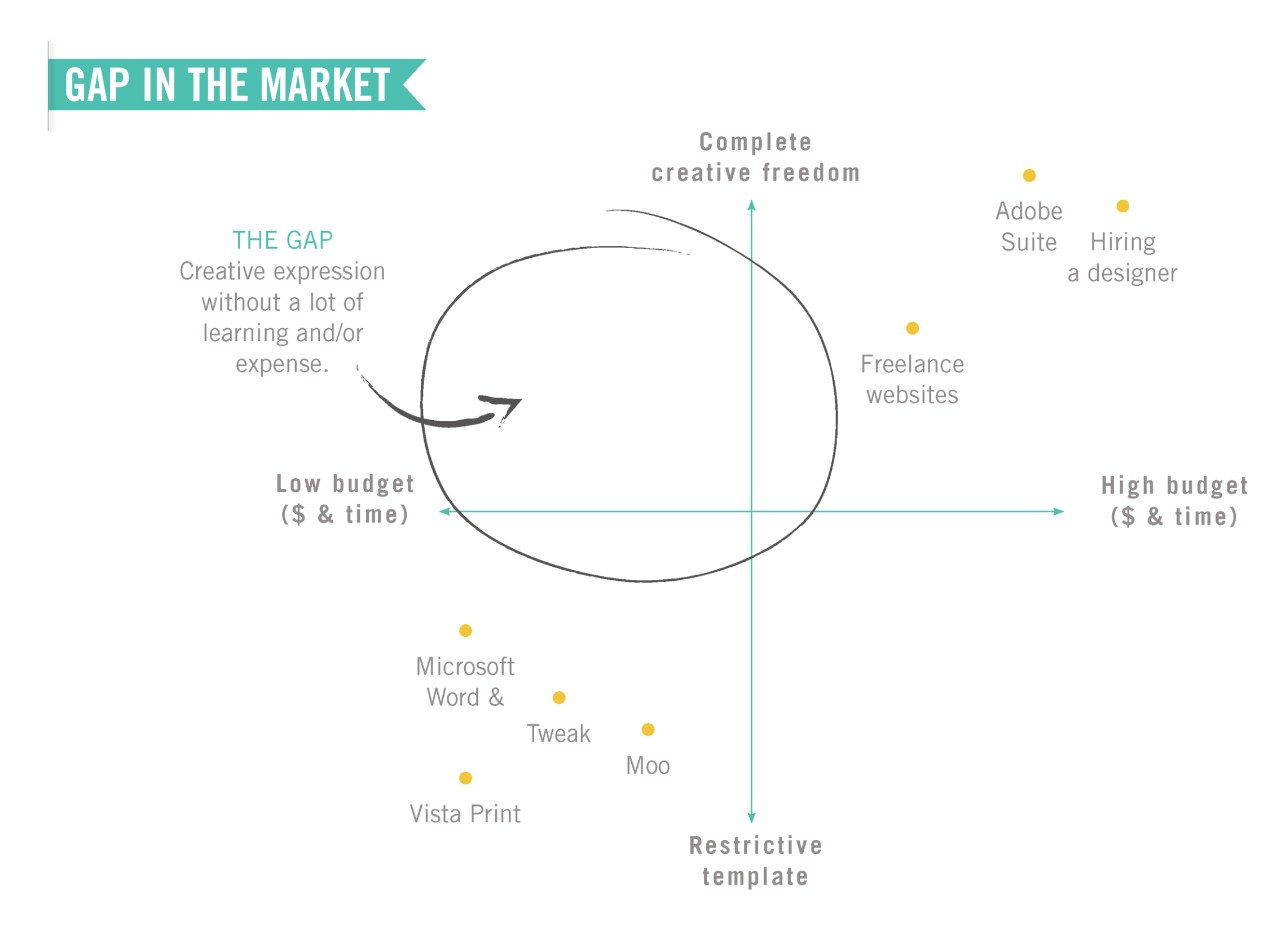
The biggest change in the last deck was not the design. Every question investors kept asking got its own slide, near the front, so it was answered before anyone could ask.
| What investors kept saying | The slide she added |
|---|---|
| They didn't understand the design industry. | The professional design process, step by step (slide 7). |
| They couldn't see a billion-dollar opportunity. | A market size under each step: $1.8B stock photos, $24B design services, $32.6B desktop publishing, $80B printing. |
| That it was just the same as some other company. | A gap-in-the-market chart showing where everyone else sits (slide 5). |
| What if a big company threw $500 million at it? | The history of publishing: the leader of one era has never led the next (slide 2). |
Once Canva was growing fast, the decks got easy. She joked later that
“most of our pitch deck is pretty graphs going up and to the right”Melanie Perkins, SmartCompany, 2018
The first money: almost half of it was a grant
The last slide of the 2013 deck asks for $1.5 million in convertible debt, with a 15% discount and an $8 million valuation cap. In the end investors put in $1.6 million. The round closed in March 2013 and was announced as $3 million, because the Australian government added a further $1.4 million through a matching grant from Commercialisation Australia, by Melanie's own account.
What the $3 million seed was made of
The investors were a mix of funds and people who already knew the founders: Matrix Partners, InterWest, 500 Startups, Square Peg and a brand-new Australian fund called Blackbird, plus angels Bill Tai, Lars Rasmussen and Paul Bassat. Then came two more small rounds, $3.6 million in 2014 and $6 million in 2015, before anything was called a Series A.
Every round, and what it bought
Here are all 11 rounds in which Canva sold new shares. Switch between the amount raised, the valuation and the share of the company each round sold. Click any bar for the details.
Every round that put new money into Canva
Two-thirds of the money came in the last two rounds of 2021, when Canva was already worth $15 billion and more. The rounds that decided whether Canva would exist at all were small: $12.6 million in three rounds before the Series A, and $70 million from the Series A to becoming a unicorn.
There is also a story that does not show up in any table. Cameron Adams says that in an early round, a lead investor came back at the final signing and said:
“We think we overvalued you.”As told by Cameron Adams, First Round Review
They offered the same money for half the valuation. The founders walked away, put together a different round and got slightly better terms. The lesson they took: never depend on one investor, and get profitable. When Canva raised its Series B in 2016 it had not spent its Series A, and it was profitable when it became a unicorn in 2018.
The price: up at every round, then 40 times revenue
Canva's valuation, and what investors paid for each dollar of revenue
In September 2021 investors paid 40 times Canva's revenue. At the August 2025 share sale the price in dollars was about the same, $42 billion, but revenue had grown about four times, so the multiple was down to 10.5. The company got much bigger. The price per dollar of revenue came back to earth.
Who invested: one name in every round
Who put money in, round by round
Filter by type of investor, or hover over a name to see its rounds.
You can read Canva's growth from its investors: angels who knew the founders, then early-stage funds, then global growth investors from 2018, and in 2021 T. Rowe Price, a fund that mostly buys shares in public companies. Blackbird is in all 11 rounds. Its first cheque was $250,000 in 2013, before there was a product. When Canva became a unicorn, Blackbird's Niki Scevak called it
“one of the fastest growing SaaS companies in history”Niki Scevak, Blackbird, AVCJ, 2018
The cap table: what the founders kept
Canva is private, so there is no public share register. But we can build a fair picture from every round's size and price, Forbes' estimates for the founders and what Blackbird has said about its own stake.
Canva's cap table, our best estimate
Why did the founders keep so much? Because most rounds were small compared with the price. The Series A sold about 9% of the company, and the $200 million round in 2021 only about half a percent. From the Series A to 2021, Canva sold about 23% in total. Try it yourself: what if every round had been bigger?
What if Canva had raised bigger rounds?
Drag the slider to make every priced round bigger or smaller, at the same valuations. The founders' combined stake updates.
Then Melanie and Cliff decided to give most of theirs away. In 2021 they committed about 30% of Canva to the Canva Foundation and signed the Giving Pledge. If you want to see what different round sizes and prices do to your own ownership, you can model it in CapLab on The Founders' Stack.
The business behind the price
Users and revenue, as announced by Canva
Canva grew from about 2.3 million users in 2015 to 265 million monthly active users at the end of 2025, more than 31 million of them paying. Annualized revenue went from about $500 million in April 2021 to $4 billion at the end of 2025. It was profitable as early as 2017.
But "profitable" depends on how you count. Canva says it has been profitable on a free cash flow basis for nine years. Its Australian accounts show about $692 million of statutory losses from 2022 to 2024, mostly because shares paid to staff count as an expense. Canva's view is that this
“does not reflect the underlying strength of our performance”Canva, via Startup Daily, 2026
With no new money since 2021, Canva paid for its acquisitions itself: Zeetings, Pexels and Pixabay, Kaleido, Smartmockups, Flourish, then in 2024 the Affinity design apps and the AI company Leonardo.Ai.
After the last round: no new money, only share sales
Since September 2021 every deal has been a share sale. Staff and early investors sold shares they already owned. The money went to them, not to Canva. That is why you see such different totals for Canva online.
Why you see different totals for Canva
What Canva was worth, depending on who you ask
Turn each type on or off. Hover over a dot for the details.
2026: the hardest year
In August 2026 Canva cut its revenue growth forecast for the year from 30% to 20%, because AI was costing too much to run. Revenue in the June quarter was still $921.9 million, up 25%, with $1.47 billion in cash. But slower growth changes the price, and investors marked Canva down to between $30 and $39 billion. Melanie called the slowdown a
“deliberate decision to get the economics right”Melanie Perkins, via Startup Daily, August 2026
On 4 November came a restructure affecting 1,271 people, about 22% of staff. Everyone leaving gets at least six months' salary, the one-year vesting cliff was removed for recent hires, and anyone who wants to start a business can apply for a $10,000 grant with no equity taken. In her memo she wrote that this had been the company's hardest year yet.
What founders can take from Canva
- Change the deck after every no, not the idea. Write down every question you get. If it comes up three times, it needs a slide near the front.
- Fix the team before you fix the deck. Canva's first investor had one condition: a technical co-founder.
- Use every kind of money you can get. Almost half of the seed, $1.4 million, was a government grant.
- A second or third small round is normal. Canva raised three times before its Series A.
- Raise before you need to, and keep a second option. That is what let Canva walk away from a halved valuation.
- Watch the size of your round against your valuation. It is why the founders still own about 45%.
- A valuation is a price at one point in time. Canva went from $40 billion to about $13 billion in one investor's books, back to $42 billion, and down again.
And if you are a few dozen no's in, you are not doing it wrong. Melanie heard more than a hundred before the first yes.
Method and sources
How we built this
- Rounds, valuations, investors and price-to-revenue multiples: Dealroom, accessed 17 November 2026.
- New money counts only the 11 rounds in which Canva sold new shares: $568.6 million.
- Revenue and users: only figures Canva itself announced, as reported by the press.
- Ownership: Forbes estimates and Blackbird's own statements. The split at the start is our inference.
- All amounts in US dollars unless marked A$.
Where the sources disagree
- Seed size: $3 million in Dealroom and the 2013 press; some trackers show $6.6 million.
- The 2018 lead: Sequoia China in TechCrunch and AVCJ; some Australian outlets say Blackbird.
- The "overvalued" round: Cameron Adams gives no year or round name.
- 2026 marks: T. Rowe Price's mark appears as $38.2 billion and later as $30.4 billion at 31 August.
Main sources
- Dealroom, Canva · Melanie Perkins on Medium · 2013 deck
- First Round Review · Forbes Australia · Blackbird
- Startup Daily, August 2026 · TechCrunch, November 2026
- The full list of sources, figure by figure, is in the PDF.
This is an independent report. It is not affiliated with or endorsed by Canva. Nothing here is investment advice.
Get the next one
Startup Case Study and The Other 95% go to Founders' Capital readers first.
Subscribe